How to Choose a Hairstyle That Matches Your Face Shape
A 2023 survey by a leading hair care brand found that over 60% of people leave the salon feeling underwhelmed — not because of the stylist’s skill, but because they walked in without knowing what they actually needed. The culprit? Choosing a hairstyle based on a celebrity photo rather than their own face shape.
Knowing how to choose a hairstyle that matches your face shape is one of the most practical — and most overlooked — skills in personal grooming. It doesn’t require a degree in aesthetics. It requires a mirror, a few minutes, and the right framework. I’ve seen clients transform their entire look not by changing their hair color or length dramatically, but simply by understanding the geometry of their own face.
This guide walks you through everything: how to identify your face shape accurately, what hairstyles work best for each shape, and the most common mistakes to avoid. Whether you’re heading to the salon next week or just exploring options, this is the roadmap you need.
Key Takeaways
- 🔑 Most people misidentify their face shape — use a photo-based tracing method for accuracy before choosing any hairstyle.
- 🔑 The goal of any face-shape-based hairstyle is to visually approximate an oval, the shape considered most balanced by professional stylists.
- 🔑 Six primary face shapes (oval, round, square, heart, oblong, diamond) each have specific haircut strategies that flatter or detract.
- 🔑 Volume, length, and layering placement are the three main tools stylists use to balance facial proportions.
- 🔑 Consulting a professional stylist with your face shape knowledge in hand leads to significantly better results than walking in with just a photo.
- Try our Free Interactive app: Find Your Perfect Haircut with the Face Shape Hairstyle Finder
Disclosure: This post contains affiliate links. As an Amazon Associate, we earn from qualifying purchases, and at no extra cost to you.
Step 1 — How to Identify Your Face Shape Accurately
Before you can learn how to choose a hairstyle that matches your face shape, you need to know your actual face shape. This sounds obvious, but most people get it wrong.
Why Self-Assessment Often Fails
We tend to see our faces subjectively. We focus on features we like or dislike, not on geometric proportions. That’s why professional stylists and beauty educators consistently recommend a measurement-based or photo-based approach rather than guessing [4].
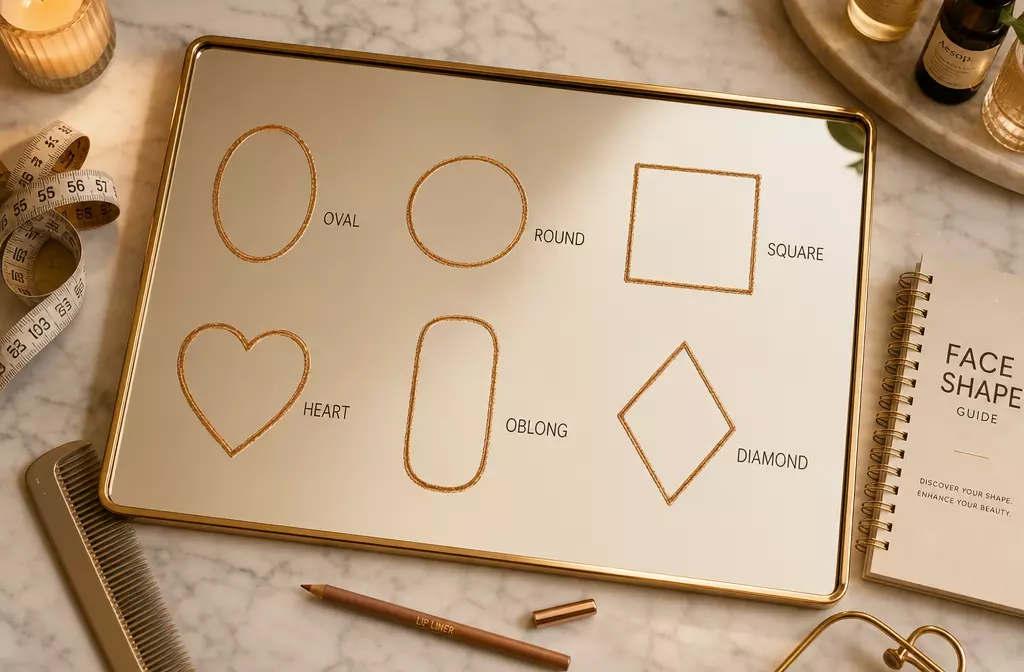
The Mirror Tracing Method
Here’s the method recommended by Luxy Hair and multiple professional stylists [4]:
- Pull all your hair back completely away from your face.
- Stand directly in front of a well-lit mirror.
- Using a washable lip liner or dry-erase marker, trace the outline of your face directly on the mirror glass.
- Step back and look at the shape you’ve drawn.
This removes the distraction of your features and lets you see the pure silhouette of your face.
The Photo Method (Highly Recommended)
For even better accuracy, use a straight-on phone photo [2]:
- Stand approximately 3 feet from the camera, at eye level.
- Use 1x zoom — no wide-angle or portrait mode, as these distort proportions.
- Pull hair back, look straight ahead with a neutral expression.
- Print the photo or use a photo editing app to trace your outline.
💡 Pro tip: Lens distortion is a real issue. A selfie taken too close with a wide-angle lens can make a square face look round and vice versa. Distance and eye-level positioning matter.
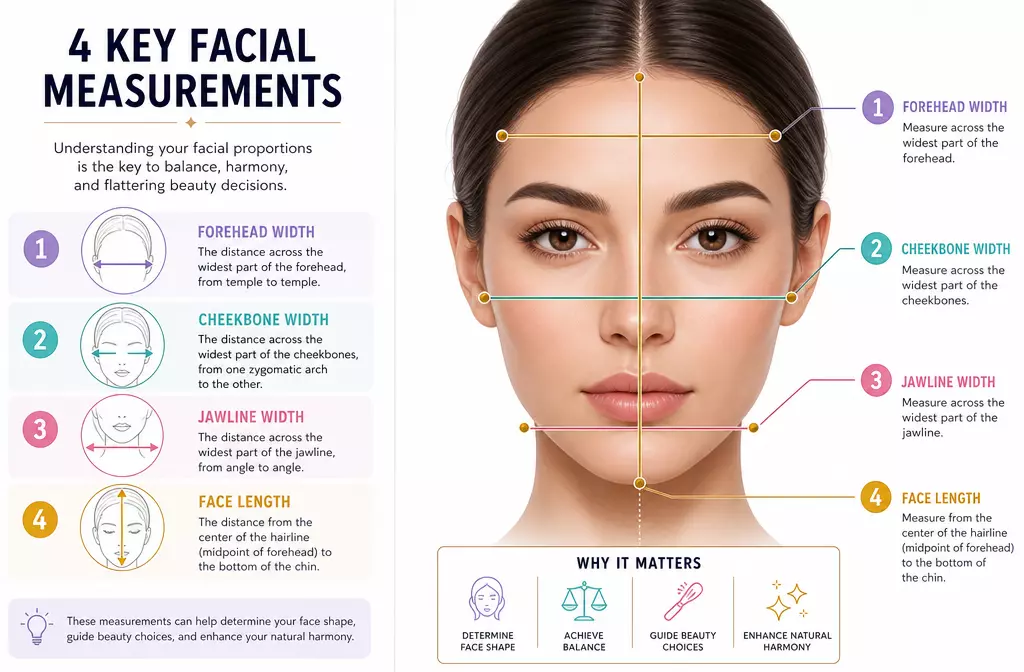
The Four Key Measurements
Once you have your outline — whether on a mirror or a photo — assess these four dimensions [3][10]:
| Measurement | What to Look For |
|---|---|
| Forehead width | Measure across the widest point of your forehead |
| Cheekbone width | Measure across the widest point of your cheeks |
| Jawline width | Measure across the widest point of your jaw |
| Face length | Measure from hairline to chin |
Compare these four numbers to identify your shape. The ratios between them define everything.
The Six Face Shapes Explained — And How to Choose a Hairstyle That Matches Your Face Shape
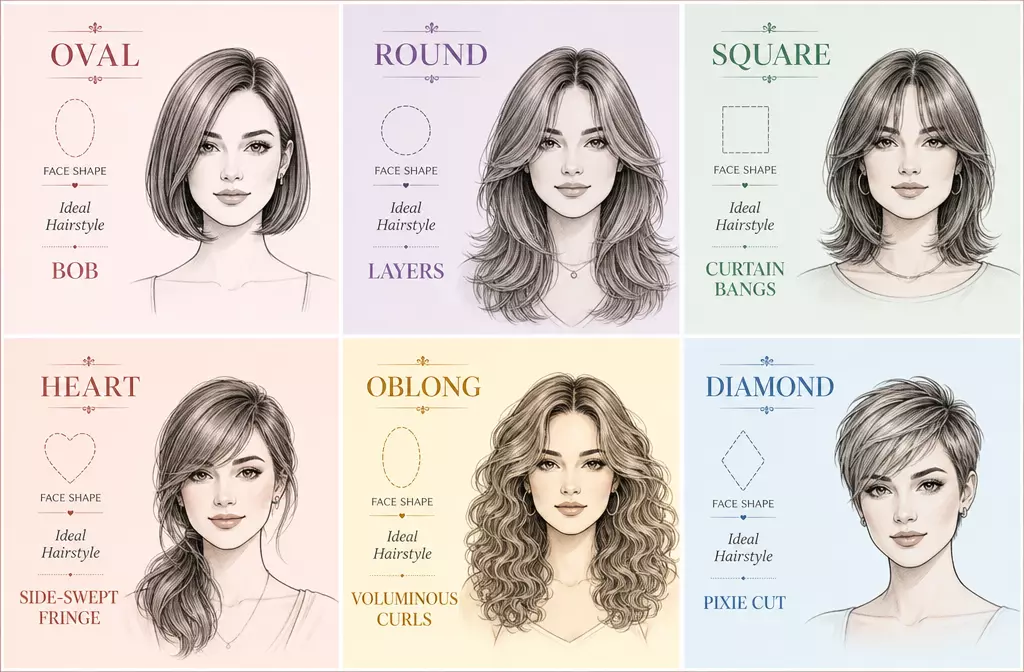
Here’s a breakdown of each major face shape, what defines it, and the hairstyle strategies that work best. The overarching principle across all shapes: the goal is to visually approximate an oval face, which is considered the most balanced proportion [1][3].
🥚 Oval Face Shape
What defines it: Face length is slightly longer than width. Cheekbones are the widest point. Forehead and jaw are roughly equal in width, with the jaw slightly narrower.
The lucky ones. An oval face shape is considered the most versatile — almost any hairstyle works [10]. That said, “anything works” can lead to choice paralysis.
Best styles:
- Long layers, bobs, pixie cuts, curtain bangs
- Both center and side parts work well
- Updos and sleek ponytails showcase the balanced proportions
Avoid: Styles that add excessive width at the cheekbones, which can distort the natural balance.
🔵 Round Face Shape
What defines it: Face width and length are nearly equal. Cheekbones are the widest point, and the jaw is soft and rounded with no sharp angles.
The strategy: Create the illusion of length and reduce apparent width [2][5].
Best styles:
- Height on top (pompadours, high buns, voluminous crown)
- Long layers that fall below the chin
- Straight or slightly wavy styles that elongate
- Side parts to break symmetry
Avoid: Very wide, blown-out styles that increase horizontal volume at the sides. Blunt bobs that end at the jaw can also widen the appearance of the face [6].
📌 Pull Quote: “For round faces, the magic is in vertical lift — add height at the crown and keep the sides sleek to create the illusion of length.” — Professional stylist consensus [5]
⬜ Square Face Shape
What defines it: Forehead, cheekbones, and jawline are all roughly equal in width. The jaw has a strong, angular appearance.
The strategy: Soften the strong jawline and add length [3][9].
Best styles:
- Layers that start below the chin
- Side-swept or curtain bangs to soften the forehead
- Soft waves and rounded layers
- Long bobs (lobs) with movement
- For men: textured crops, side-swept styles, fades that taper rather than box
Avoid: Blunt, geometric cuts that mirror the jaw’s angularity. Very short, cropped styles that emphasize the jaw width.
💜 Heart Face Shape
What defines it: Wide forehead, high cheekbones, and a narrow, pointed chin.
The strategy: Balance the wider top half by adding visual weight at the chin and jaw [4][9].
Best styles:
- Side-swept bangs to reduce forehead width
- Chin-length bobs that add volume at the jaw
- Waves or curls that start at the chin level
- Forward-directed layers that frame the lower face
Avoid: Very high-volume styles at the crown, which amplify the already-wide forehead. Center-parted styles with volume at the top can also be unflattering.
📏 Oblong / Rectangular Face Shape
What defines it: Face is significantly longer than it is wide. Forehead, cheekbones, and jaw are similar in width. The overall silhouette is long and narrow.
The strategy: Reduce the appearance of length and add width [2][7].
Best styles:
- Full, wide styles with volume at the sides
- Blunt bobs or lobs that add horizontal width
- Bangs (fringe) to shorten the perceived face length
- Layers through the mid-lengths to add fullness
Avoid: Excessive height at the crown, which elongates the face further. Very long, straight styles with no volume at the sides [6].
💎 Diamond Face Shape
What defines it: Narrow forehead and jawline with wide, prominent cheekbones. The face tapers at both the top and bottom.
The strategy: Add width at the forehead and chin to balance the prominent cheekbones [7][10].
Best styles:
- Side-swept bangs or fringe to widen the forehead
- Chin-length cuts that add width at the jaw
- Textured, layered styles with volume at the crown and chin
- Side parts that create asymmetry
Avoid: Styles that add volume only at the cheekbones, which can make the face look even wider in the middle.
Quick Reference Table 📊
| Face Shape | Key Feature | Add Volume Here | Reduce Volume Here |
|---|---|---|---|
| Oval | Balanced proportions | Anywhere | Extreme cheekbone width |
| Round | Equal width & length | Crown/top | Sides |
| Square | Strong jaw, equal widths | Chin/length | Jaw width |
| Heart | Wide forehead, narrow chin | Chin/jaw | Crown/forehead |
| Oblong | Long & narrow | Sides/mid-lengths | Crown height |
| Diamond | Wide cheekbones | Forehead & chin | Cheekbone area |
Working With Your Stylist: How to Choose a Hairstyle That Matches Your Face Shape in the Salon
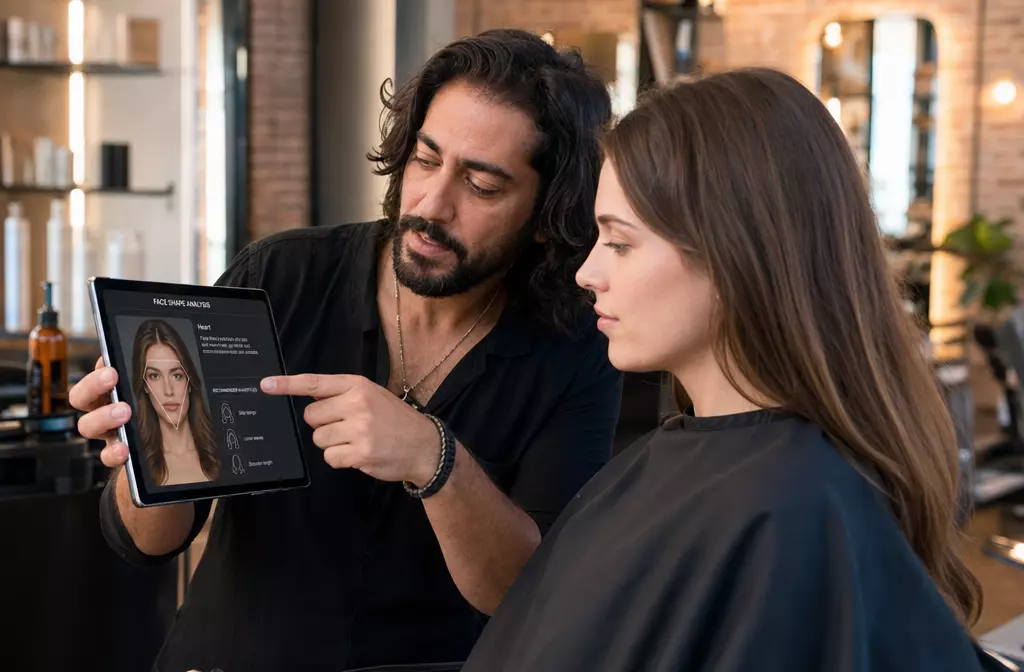
Knowing your face shape is only half the equation. The other half is communicating effectively with your stylist. I’ve watched clients walk in with a celebrity photo and walk out disappointed because the stylist had no context for why that particular style was chosen.
What to Tell Your Stylist
Before your appointment, prepare these three things:
- Your face shape — state it clearly. “I have a round face and I want to add length.”
- Your goal — what proportion are you trying to balance? “I want to soften my jawline” or “I want to reduce forehead width.”
- Your lifestyle constraints — how much time do you spend styling? Fine hair, thick hair, and curly hair all behave differently even with the same cut.
Questions to Ask
- “Given my face shape, where would you recommend placing layers?”
- “Would curtain bangs work for my face shape, or would a different bang style be better?”
- “Are there any styles I should avoid given my proportions?”
A skilled stylist will appreciate that you’ve done your homework. It turns a vague consultation into a precise, collaborative process [1].
💡 Remember: A photo of your inspiration hairstyle is still useful — just pair it with your face shape knowledge so the stylist can adapt the style to your specific proportions.
Common Mistakes to Avoid When Choosing a Hairstyle for Your Face Shape
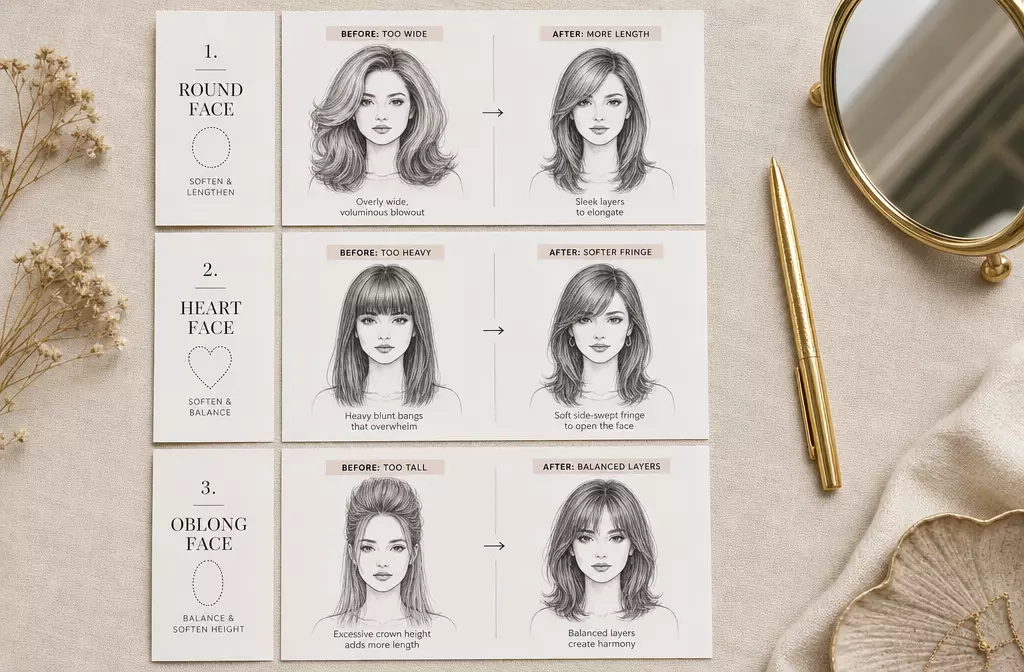
Even with the best intentions, people make predictable errors. Here are the most frequent ones — and how to sidestep them.
❌ Mistake 1: Choosing Based on Trends Alone
A trending hairstyle on social media may look incredible on the person posting it — and completely wrong on you. That’s not because you’re less attractive; it’s because their face shape may be the opposite of yours. A curtain bang that beautifully frames a heart-shaped face can overwhelm a round face by adding horizontal width.
Fix: Always filter trends through your face shape framework first.
❌ Mistake 2: Misidentifying Your Face Shape
This is the most common error. Without a measurement-based method, most people either guess incorrectly or land between two categories and pick the wrong one [4][8].
Fix: Use the photo method described in Step 1. If you’re genuinely between two shapes (e.g., oval-round or square-oblong), read the strategies for both and find the overlapping recommendations.
❌ Mistake 3: Ignoring Hair Texture
A hairstyle that works beautifully in fine, straight hair may behave completely differently in thick, coarse, or curly hair. Volume recommendations especially change based on texture — naturally voluminous hair needs less added bulk [3].
Fix: Always discuss your hair texture with your stylist alongside your face shape.
❌ Mistake 4: Forgetting That Face Shape Is One Factor Among Many
Face shape is a powerful guide, but it’s not the only variable. Your neck length, shoulder width, and overall body proportions also influence how a hairstyle looks on you [9].
Fix: Use face shape as your primary guide, but ask your stylist to factor in your full silhouette.
❌ Mistake 5: Sticking With One Style Forever
Your face shape doesn’t change dramatically, but your lifestyle, hair texture, and personal style do. A hairstyle that suited you at 25 may not be serving you at 40 — not because of age, but because your priorities and styling habits have shifted.
Fix: Revisit your hairstyle strategy every few years, especially after significant life changes.
Special Considerations: Hair Texture, Density, and Age
Fine Hair
Fine hair has less natural volume, which affects how certain face-shape strategies play out. For round faces, adding height becomes harder with fine hair — dry texturizing sprays and strategic layering can help create the illusion of volume without weight [3].
Thick or Coarse Hair
Thick hair naturally adds volume, which is great for oblong faces but can be challenging for round or heart-shaped faces. Point-cutting and thinning techniques can reduce bulk where it’s not wanted.
Curly Hair
Curly hair adds significant volume in all directions, which changes the calculus for every face shape. For round faces with curly hair, the goal is to elongate the curl pattern — diffusing for height at the crown while keeping the sides more defined and less voluminous [5].
Mature Hair
As hair texture changes with age — often becoming finer or more porous — the same cut may behave differently. Many stylists recommend reassessing your hairstyle strategy in your 40s and 50s, not to follow age-based rules, but to account for the new texture reality [1].
The Face Shape + Hairstyle Framework at a Glance
Here’s a condensed cheat sheet you can screenshot and bring to your next salon appointment:
| Face Shape | Top Style Picks | Key Technique | Avoid |
|---|---|---|---|
| Oval | Anything! Layers, bobs, pixie | Maintain balance | Extreme cheekbone volume |
| Round | High bun, long layers, side part | Add vertical height | Wide side volume |
| Square | Lob, curtain bangs, soft waves | Soften jaw angles | Geometric, blunt cuts |
| Heart | Chin bob, side-swept bangs | Add jaw volume | High crown volume |
| Oblong | Blunt bob, bangs, wide layers | Add horizontal width | Extra crown height |
| Diamond | Side-swept fringe, chin-length | Widen forehead & chin | Cheekbone-only volume |
Conclusion: Your Next Steps to the Perfect Hairstyle
Understanding how to choose a hairstyle that matches your face shape is not about following rigid rules — it’s about having a framework that makes every salon visit more intentional and every style decision more informed.
Here’s your action plan:
- Identify your face shape today using the photo method. Take a straight-on photo at eye level, trace your outline, and compare it to the six shapes described above.
- Note your hair texture and density — fine, thick, curly, or straight — because this affects how any face-shape strategy plays out in practice.
- Research 3–5 hairstyles that match your face shape recommendations and save photos of each.
- Book a consultation (not just a cut) with a stylist. Walk in with your face shape, your goal, and your inspiration photos. Ask them to adapt rather than copy.
- Revisit your strategy every 2–3 years or after major lifestyle changes, because your priorities and hair texture evolve.
The right hairstyle doesn’t just change how you look — it changes how you feel walking into a room. That confidence is worth the 20 minutes it takes to do this properly. Start with the mirror. The rest follows.
References
[1] How To Pick The Perfect Haircut For Your Face Shape – https://nikkolemichaels.com/hair-salon/how-to-pick-the-perfect-haircut-for-your-face-shape/
[2] Mens Haircuts By Face Shape – https://clippersbarbershop-tx.com/mens-haircuts-by-face-shape/
[3] The Ultimate Guide To Choosing The Perfect Hairstyle For Your Face Shape – https://www.studiofxak.com/blog/the-ultimate-guide-to-choosing-the-perfect-hairstyle-for-your-face-shape/
[4] Hairstyles For Different Face Shapes – https://www.luxyhair.com/blogs/hair-blog/hairstyles-for-different-face-shapes
[5] Watch – https://www.youtube.com/watch?v=PDgLMdn751c
[6] Watch – https://www.youtube.com/watch?v=zXIofF28eYk
[7] Face Shape Guide – https://forteseries.com/pages/face-shape-guide
[8] A Cool Guide To Choose The Hairstyle For Your – https://www.reddit.com/r/coolguides/comments/156pl49/a_cool_guide_to_choose_the_hairstyle_for_your/
[9] Good Hair Styles For Your Face Shape – https://www.justineleconte.com/blogs/news/good-hair-styles-for-your-face-shapehowtodetermineyourshape
[10] Best Hairstyles For Every Face Shape – https://www.greatclips.com/blog/best-hairstyles-for-every-face-shape