How to Read a Shampoo Label Like a Pro: A Buyer’s Guide
The average shampoo bottle contains between 20 and 30 individual ingredients — yet most people spend less than 10 seconds reading the label before tossing it into their cart. That split-second decision could be the reason your hair feels dry, your scalp itches, or your color fades faster than it should.
This guide — How to Read a Shampoo Label Like a Pro: A Buyer’s Guide — is built to change that. Whether you’re navigating a drugstore aisle or scrolling through an online beauty retailer in 2026, understanding what’s actually inside your shampoo bottle puts the power back in your hands. No chemistry degree required.
Disclosure: This post contains affiliate links. As an Amazon Associate, we earn from qualifying purchases, and at no extra cost to you.
Key Takeaways 📌
- Ingredients are listed by concentration — the first five matter most for your hair.
- Not all “natural” or “sulfate-free” labels mean what you think — marketing terms are largely unregulated.
- Some common ingredients are genuinely harmful for certain hair types or scalp conditions.
- Fragrance (“parfum”) is a catch-all term that can hide dozens of undisclosed chemicals.
- Matching ingredients to your specific hair type is the single most effective buying strategy.
- Try our Free Interactive app: Shampoo Ingredient Decoder: Transform Your Haircare Routine
Why Shampoo Labels Are More Confusing Than They Need to Be
Let me be honest: shampoo labels are designed to be confusing — at least partly. Brands know that most shoppers respond to front-of-bottle claims like “moisturizing,” “volumizing,” or “color-safe” without ever flipping the bottle over. The real story is on the back, in that tiny font, in that long list of unpronounceable names.
The cosmetics industry in most countries follows a standardized naming system called INCI (International Nomenclature of Cosmetic Ingredients). This means ingredients are listed using their scientific or Latin names — which is why you’ll see Cocos Nucifera Oil instead of “coconut oil.”
💡 Pull Quote: “The front of the bottle sells the dream. The back of the bottle tells the truth.”
Understanding INCI naming is your first step toward becoming a smarter shampoo buyer.
The Golden Rule: Ingredient Order Matters
Here’s the most important rule in reading any cosmetic label: ingredients are listed in descending order of concentration. The ingredient at the top of the list makes up the largest percentage of the formula. The one at the bottom? Likely less than 1%.
What This Means in Practice
| Position on List | Approximate Concentration | Examples |
|---|---|---|
| 1st–3rd | 60–90% of formula | Water (Aqua), Sodium Laureth Sulfate |
| 4th–7th | 5–15% of formula | Conditioning agents, thickeners |
| 8th–15th | 1–5% of formula | Active ingredients, botanicals |
| 16th and beyond | Less than 1% | Preservatives, fragrances, vitamins |
This is why it’s frustrating when a shampoo boasts “with argan oil” on the front, but argan oil appears as ingredient #22 on the back. At that concentration, it’s essentially a marketing claim, not a functional benefit.
Pro tip: If a star ingredient appears after the preservatives (usually phenoxyethanol or parabens), it’s likely present in a negligible amount.
Decoding the Most Common Shampoo Ingredients
This is where How to Read a Shampoo Label Like a Pro: A Buyer’s Guide gets practical. Let’s break down the ingredients you’ll encounter most often — and what they actually do.
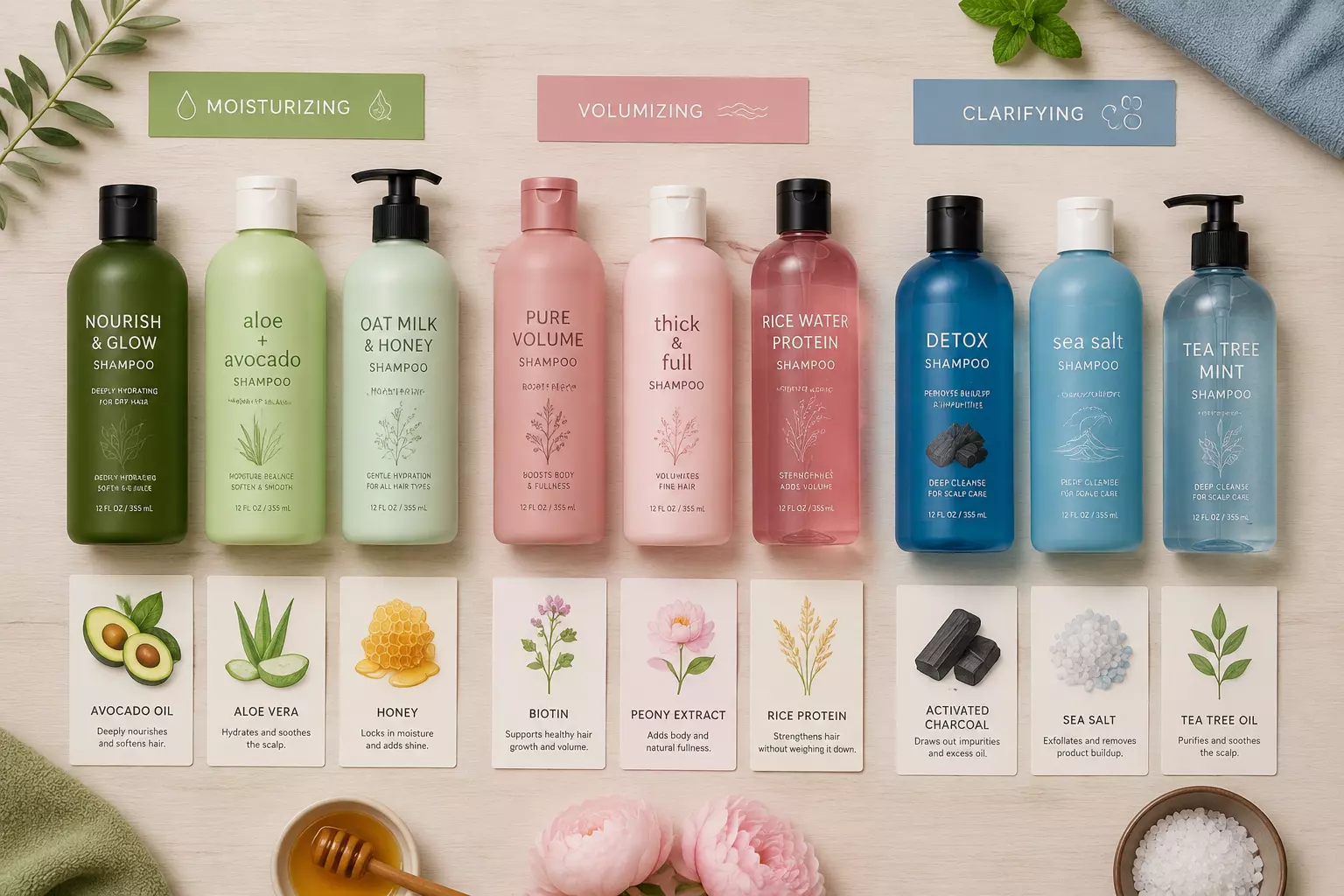
🧼 Cleansing Agents (Surfactants)
Surfactants are the workhorses of any shampoo. They lift oil and dirt from your scalp and hair shaft.
Common surfactants and their strength:
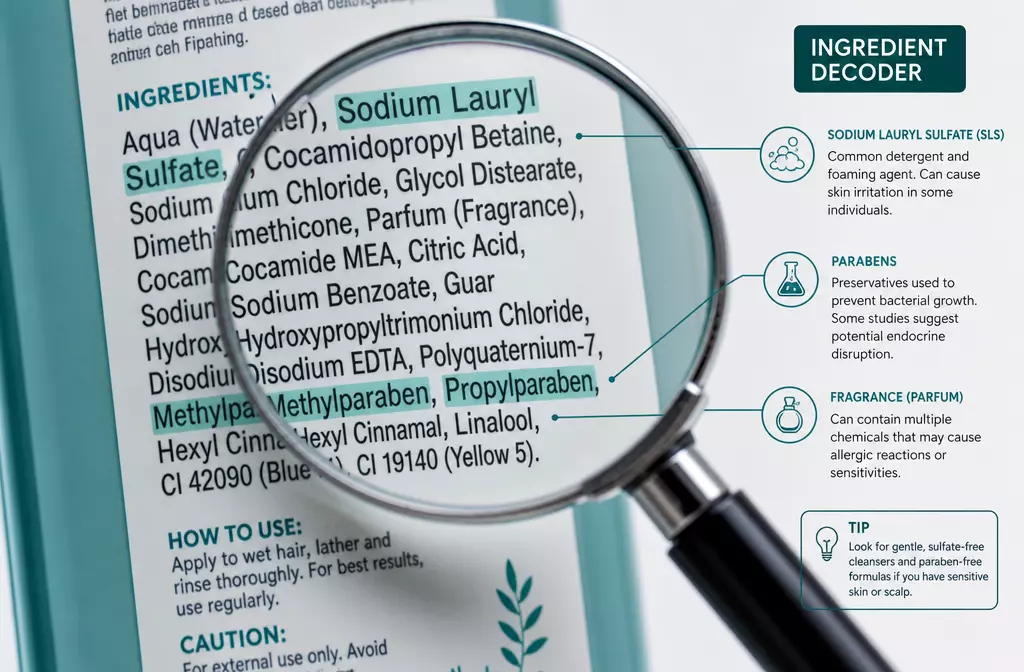
- Sodium Lauryl Sulfate (SLS) — Very strong. Effective cleanser but can strip natural oils and irritate sensitive scalps. Often the #1 or #2 ingredient.
- Sodium Laureth Sulfate (SLES) — Milder than SLS. More common in mainstream shampoos. Still a sulfate.
- Cocamidopropyl Betaine — Derived from coconut oil. Gentle, often used in “sensitive” or “baby” formulas.
- Sodium Cocoyl Isethionate — Very mild, creamy lather. Common in sulfate-free shampoos.
- Decyl Glucoside / Coco Glucoside — Plant-derived, biodegradable, gentle. Favored in natural and organic formulas.
Should you avoid sulfates? Not necessarily. If you have an oily scalp, SLS or SLES can be perfectly effective. If you have color-treated, dry, or curly hair — or a sensitive scalp — a sulfate-free formula is worth exploring.
💧 Conditioning and Moisturizing Agents
These ingredients smooth the hair cuticle and add softness.
- Dimethicone / Cyclopentasiloxane — Silicones that coat the hair shaft for instant smoothness. Can build up over time without clarifying shampoos.
- Cetyl Alcohol / Cetearyl Alcohol — Despite the name, these are fatty alcohols — moisturizing, not drying.
- Glycerin (Glycerol) — A humectant that draws moisture into the hair shaft.
- Panthenol (Pro-Vitamin B5) — Penetrates the hair shaft, adds moisture and shine.
- Hydrolyzed Keratin / Hydrolyzed Wheat Protein — Strengthening proteins that temporarily fill gaps in damaged hair.
🌿 Botanical Extracts
These are the “hero” ingredients brands love to put on the front label. They can be genuinely beneficial — but only if they appear high enough in the formula.
- Aloe Barbadensis Leaf Juice — Soothing, hydrating, great for scalp health.
- Camellia Sinensis (Green Tea) Extract — Antioxidant, may support scalp health.
- Rosmarinus Officinalis (Rosemary) Extract — Growing evidence supports its role in scalp circulation and hair density.
- Argania Spinosa (Argan) Kernel Oil — Nourishing for dry, frizzy hair when present in meaningful amounts.
🧪 Preservatives
All water-based products need preservatives to prevent bacterial and mold growth. This is non-negotiable for product safety.
- Phenoxyethanol — One of the most common modern preservatives. Generally considered safe at regulated levels.
- Sodium Benzoate — Mild preservative, often used in “natural” formulas.
- Parabens (Methylparaben, Propylparaben) — Effective and long-used, but controversial due to studies on endocrine disruption. Many brands have moved away from them.
- DMDM Hydantoin / Formaldehyde Releasers — These slowly release formaldehyde as a preservative. Considered more concerning, especially for those with sensitivities.
Red Flags: Ingredients to Watch Out For
Not every ingredient on a shampoo label deserves equal trust. Here are the ones worth scrutinizing — especially if you have specific concerns.
⚠️ The Fragrance Problem
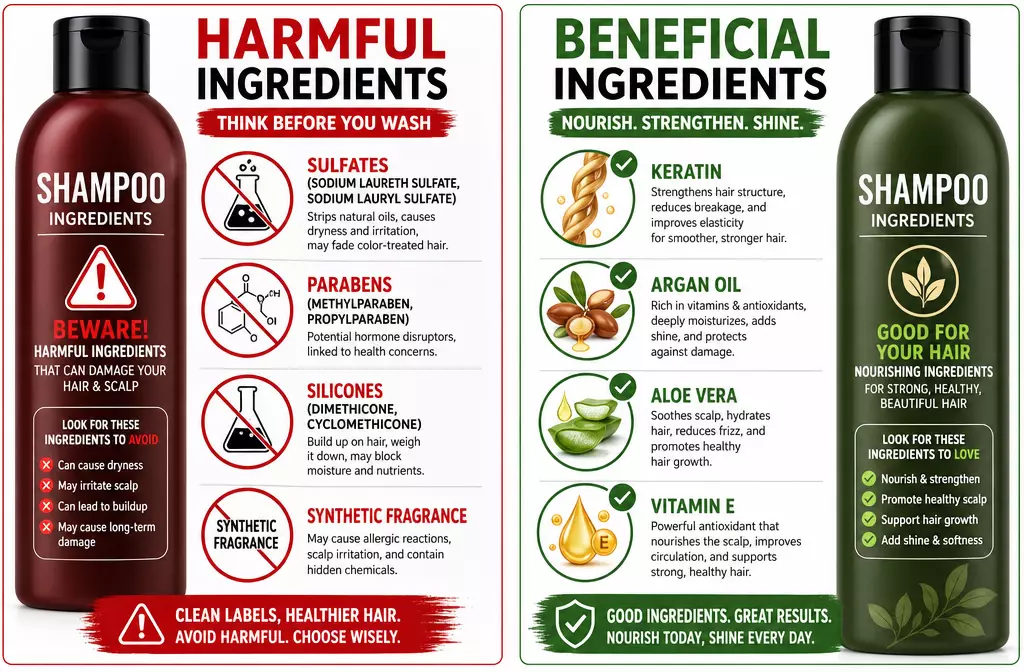
The word “Fragrance” (or “Parfum”) on a label is a legal loophole. Under most cosmetic regulations, fragrance formulas are considered trade secrets, meaning brands don’t have to disclose what’s inside. A single “fragrance” entry can represent a blend of 50–100 individual chemicals — some of which are known allergens or irritants.
💡 Pull Quote: “Fragrance is the single most opaque ingredient on any beauty label — and one of the most common causes of scalp irritation.”
If you have a sensitive scalp or known allergies, look for shampoos labeled “fragrance-free” (not just “unscented” — unscented products can still contain masking fragrances).
⚠️ Sulfates and Scalp Sensitivity
As covered above, SLS can be too harsh for some hair types. Signs that sulfates may be problematic for you:
- Scalp feels tight or itchy after washing
- Hair feels straw-like after shampooing
- Color fades quickly after dyeing
⚠️ Silicone Build-Up
Silicones like dimethicone aren’t inherently harmful, but they can accumulate on the hair shaft over time, making hair feel heavy and dull. If you use silicone-based products regularly, incorporate a clarifying shampoo once or twice a month.
⚠️ Drying Alcohols
Watch for short-chain alcohols high on the ingredient list:
- Alcohol Denat.
- Isopropyl Alcohol
- Ethanol
These can strip moisture. (Remember: fatty alcohols like cetyl alcohol are fine and actually moisturizing.)
How to Match Ingredients to Your Hair Type
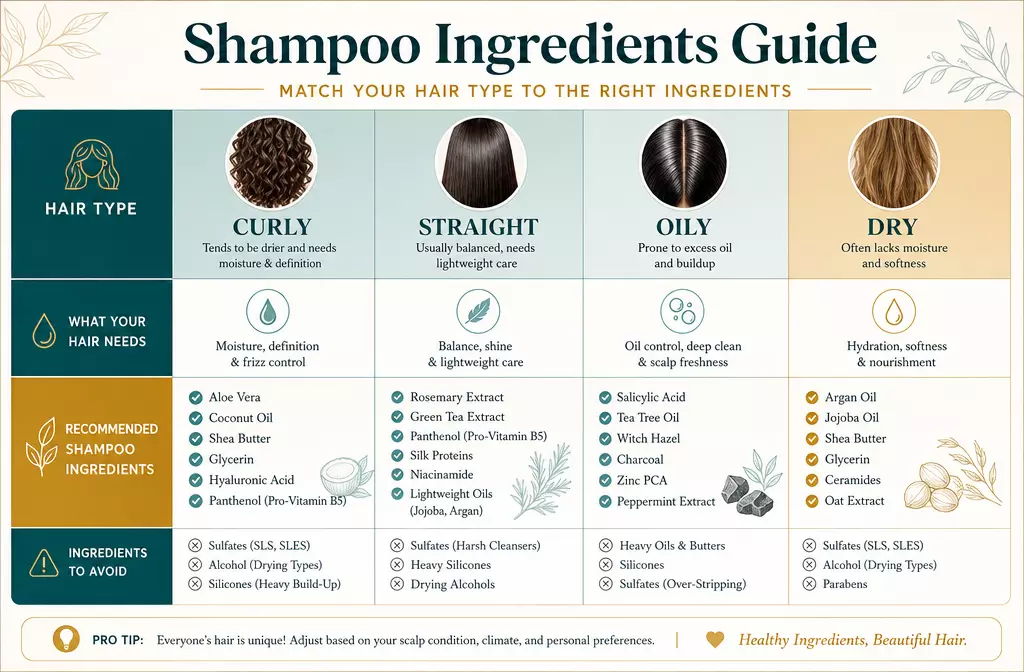
This is the practical heart of How to Read a Shampoo Label Like a Pro: A Buyer’s Guide. Knowing what to look for — and what to avoid — based on your specific hair type transforms label-reading from an overwhelming chore into a targeted skill.
🌊 Oily Scalp / Fine Hair
Look for:
- Clarifying surfactants (SLES, SLS in moderation)
- Salicylic acid (exfoliates scalp)
- Tea tree oil (Melaleuca Alternifolia)
- Zinc pyrithione (anti-dandruff, oil control)
Avoid:
- Heavy silicones (dimethicone, cyclomethicone)
- Thick oils high on the list (coconut oil, shea butter)
- Heavy proteins that weigh hair down
🔥 Dry / Damaged Hair
Look for:
- Hydrolyzed proteins (keratin, wheat, silk)
- Glycerin and other humectants
- Fatty alcohols (cetyl, stearyl)
- Panthenol (Pro-Vitamin B5)
- Argan or jojoba oil in the top 10 ingredients
Avoid:
- Sulfates (SLS/SLES) as primary cleansers
- Drying alcohols
- High-fragrance formulas
🌀 Curly / Coily Hair
Look for:
- Gentle surfactants (coco glucoside, cocamidopropyl betaine)
- Humectants (glycerin, aloe vera)
- Emollients (shea butter, avocado oil)
- Slip agents for detangling
Avoid:
- Sulfates (disrupt curl pattern)
- Drying alcohols
- Heavy silicones (unless you clarify regularly)
🎨 Color-Treated Hair
Look for:
- Sulfate-free formulas
- UV filters (benzophenone-4)
- Antioxidants (vitamin E / Tocopherol)
- Gentle cleansers
Avoid:
- SLS (accelerates color fade)
- Clarifying formulas for everyday use
- High-pH formulas (open the cuticle, releasing color)
Understanding Front-of-Bottle Claims: Marketing vs. Reality
Let’s talk about the claims that actually drive purchasing decisions — and how much they really mean.
| Claim | What It Means | What It Doesn’t Mean |
|---|---|---|
| “Natural” | No legal definition in most markets | That all ingredients are plant-derived |
| “Sulfate-Free” | No SLS or SLES | That it’s gentle — other harsh surfactants may be present |
| “Paraben-Free” | No parabens | That it’s preservative-free (other preservatives are used) |
| “Hypoallergenic” | Formulated to minimize allergens | That it won’t cause reactions for everyone |
| “Dermatologist Tested” | A dermatologist reviewed or tested it | That it was clinically proven effective |
| “Organic” | May contain some organic-certified ingredients | That the entire formula is organic |
| “pH-Balanced” | Formulated near hair’s natural pH (4.5–5.5) | A specific, regulated standard |
💡 Pull Quote: “In the beauty industry, ‘natural’ is a marketing term, not a safety certification. Always flip the bottle.”
A Step-by-Step Label Reading Checklist
Use this checklist every time you evaluate a new shampoo — whether you’re standing in a store or reading a product page online.
✅ Step 1: Check the first 5 ingredients
These make up the bulk of the formula. Are the primary surfactants appropriate for your hair type?
✅ Step 2: Identify the cleansing agents
Are they sulfate-based or sulfate-free? Match to your needs.
✅ Step 3: Look for your target active ingredients
Do the beneficial ingredients (proteins, oils, botanicals) appear in the top half of the list?
✅ Step 4: Scan for red-flag ingredients
Check for formaldehyde releasers, drying alcohols, or high-fragrance entries if you have sensitivities.
✅ Step 5: Evaluate front-of-bottle claims critically
Cross-reference the marketing claims against the actual ingredient list.
✅ Step 6: Check the pH (if available)
Ideal shampoo pH is between 4.5 and 5.5. Some brands now list this or it’s available on their website.
✅ Step 7: Consider the full routine
Your shampoo works in context with your conditioner, treatments, and styling products. Silicones in your conditioner affect how you should choose your shampoo.
Tools and Resources for Deeper Research
You don’t have to memorize every ingredient. In 2026, there are excellent digital tools that do the heavy lifting for you.
- EWG Skin Deep Database — Rates cosmetic ingredients on a hazard scale based on available research. Free to use.
- CosDNA — Analyzes cosmetic formulas, flags potential acne triggers and irritants.
- INCIDecoder — Explains every ingredient in plain language. Paste in an ingredient list and get a full breakdown.
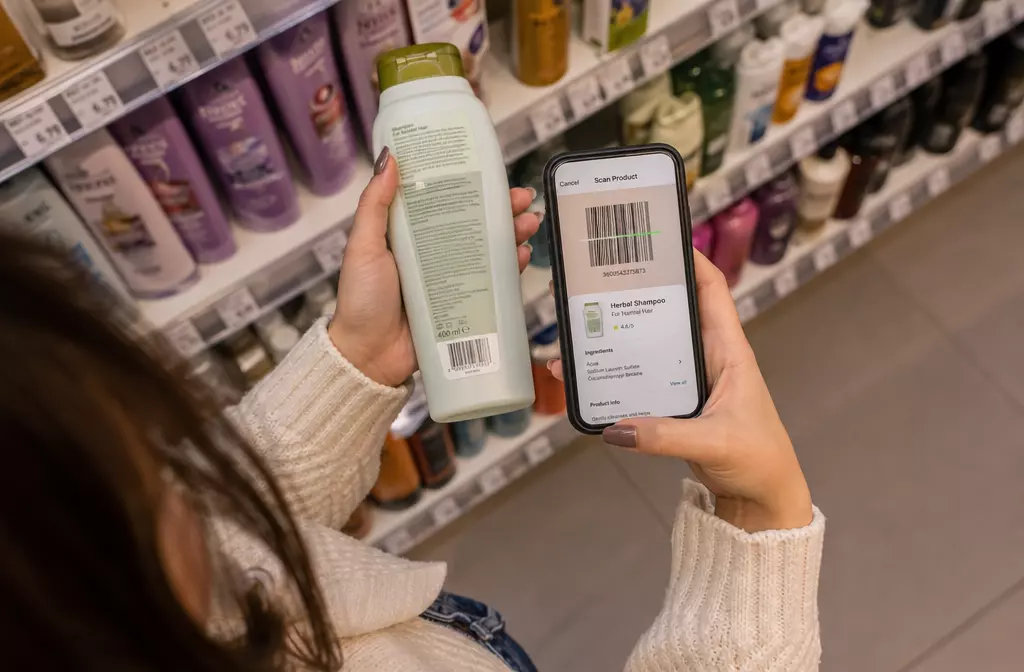
- Think Dirty App — Scans product barcodes and rates formulas based on ingredient safety.
These tools are especially useful when you’re comparing two products and can’t tell which is genuinely better for your needs.
Conclusion: Your Action Plan for Smarter Shampoo Shopping
Reading a shampoo label like a pro isn’t about memorizing a chemistry textbook. It’s about knowing a handful of key principles and applying them consistently. Here’s your action plan:
- Flip the bottle first. Always read the ingredient list before the front-of-bottle claims.
- Focus on the top 5 ingredients. They define the formula’s performance.
- Match ingredients to your hair type using the guide above.
- Use digital tools like INCIDecoder or CosDNA when you’re unsure about a specific ingredient.
- Be skeptical of marketing terms — “natural,” “organic,” and “hypoallergenic” are largely unregulated.
- Watch for fragrance, formaldehyde releasers, and drying alcohols if you have a sensitive scalp.
- Reassess your shampoo every season — hair needs change with climate, diet, and lifestyle.
The beauty industry spends billions on packaging and marketing designed to bypass your critical thinking. Mastering How to Read a Shampoo Label Like a Pro: A Buyer’s Guide means you’re no longer buying the story on the front — you’re buying the formula on the back. And that’s where the real difference lies.