
Over 60% of women report experiencing some form of hair damage — yet most reach for the wrong products and wonder why their hair keeps breaking. If you’ve been stuck in that frustrating cycle, this guide on how to fix damaged hair: 7 repair treatments that really work is exactly what you need. I’ve spent years researching hair science and testing treatments, and I’m cutting through the noise to give you what actually makes a difference.
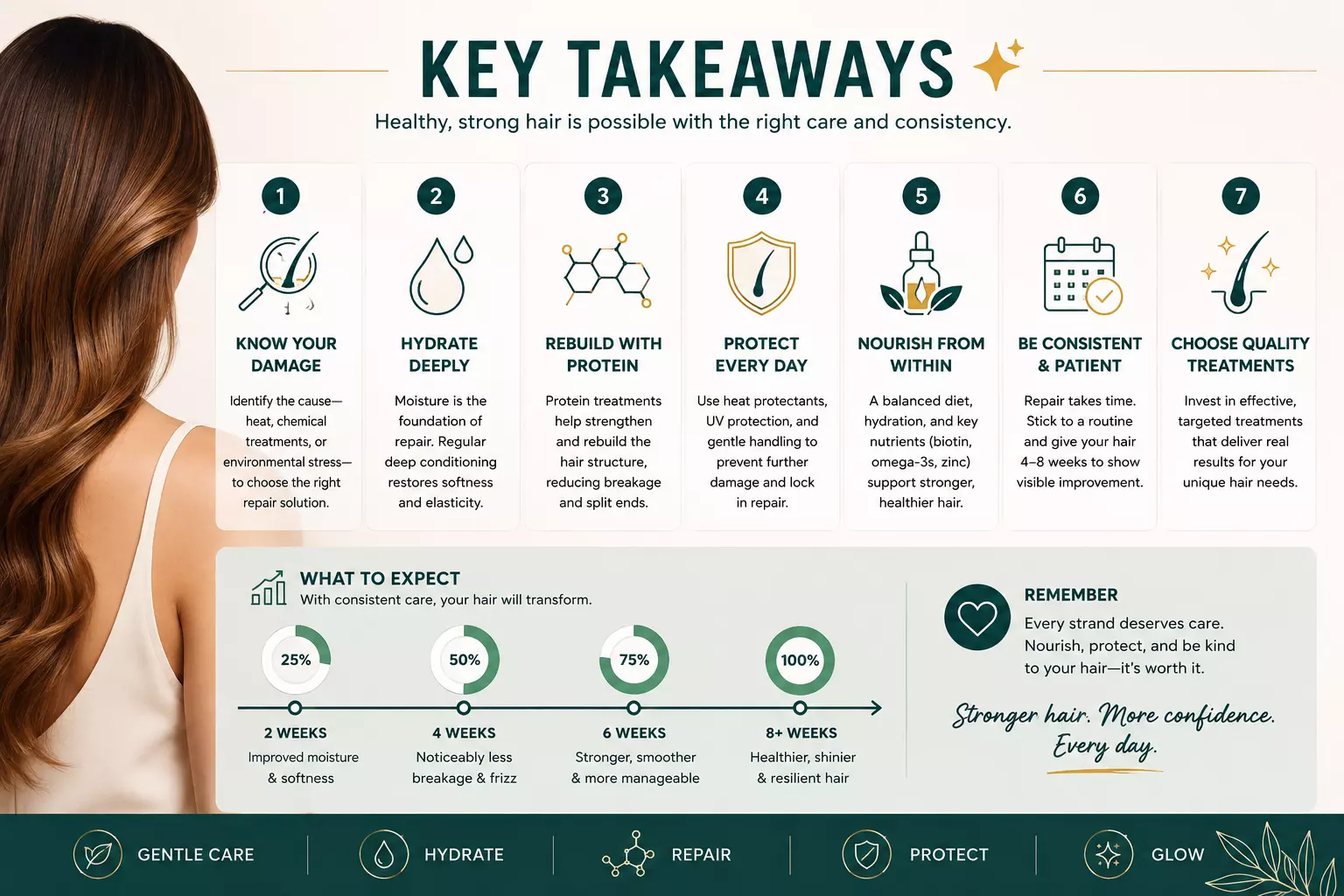
Key Takeaways 📌
- Hair damage is structural — effective repair requires targeting the cortex, cuticle, and bonds inside the strand, not just the surface.
- Protein and moisture must be balanced — too much of either causes more damage.
- Bond-building treatments (like those containing bis-aminopropyl diglycol dimaleate) are among the most scientifically supported repair methods available in 2026.
- Consistency beats intensity — one weekly treatment plus daily protective habits outperforms occasional deep treatments every time.
- Trimming damaged ends is not optional — no product can fully reverse severe split ends or breakage.
- Try our Free Interactive app: Build Your Personalized Hair Repair Routine in Minutes
Understanding Hair Damage: What’s Really Happening Inside Your Strands
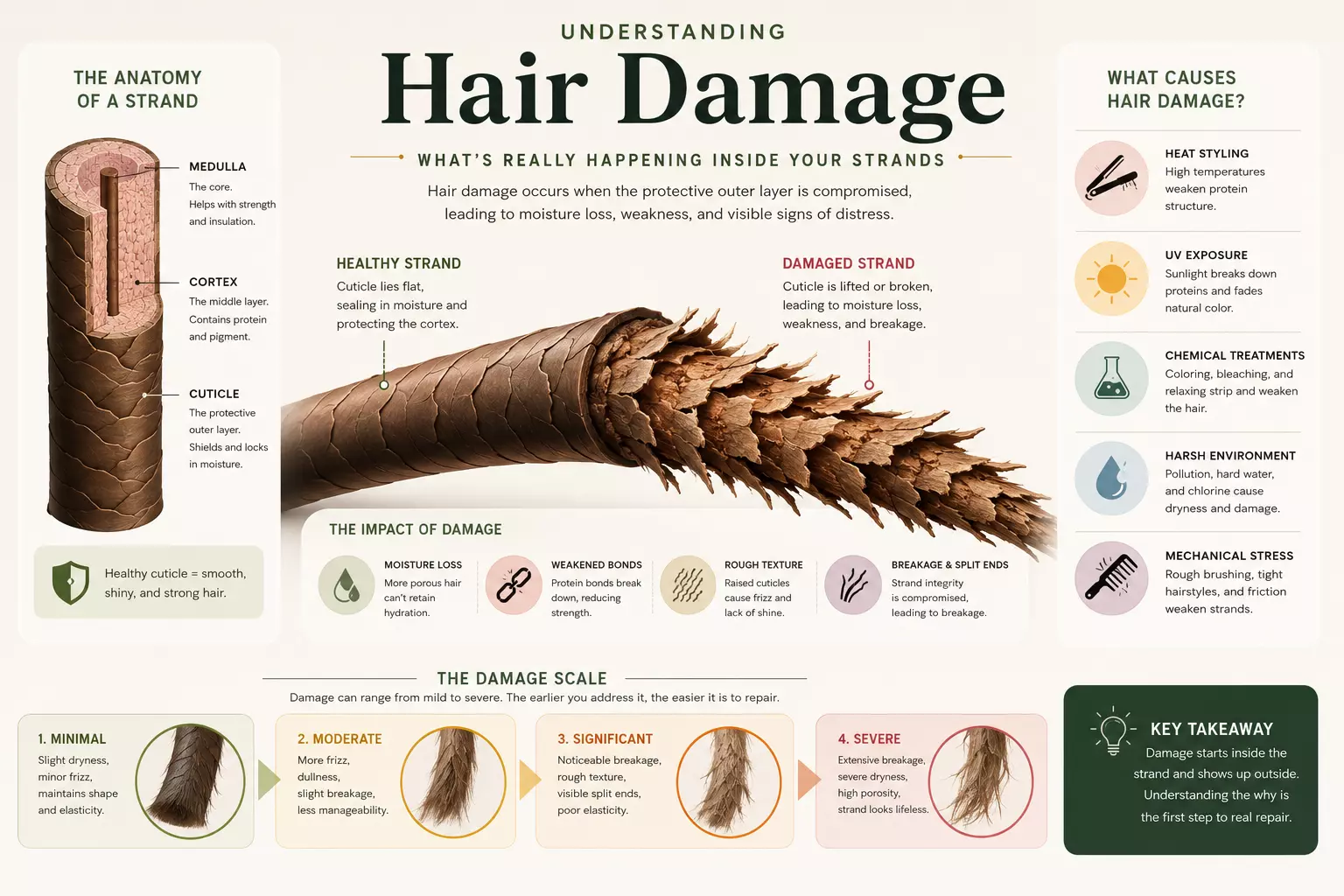
Before you can fix something, you need to understand what’s broken. Hair is made up of three layers:
- Cuticle — the outer protective layer of overlapping scales
- Cortex — the inner core that holds keratin proteins and disulfide bonds
- Medulla — the innermost channel (not present in all hair types)
When hair is damaged, the cuticle lifts or chips away, leaving the cortex exposed. Disulfide bonds — the chemical links that give hair its strength and elasticity — break. Moisture escapes. The result? Frizz, breakage, dullness, and that awful snapping sound when you brush.
Common Causes of Hair Damage
| Damage Type | What It Does | Common Culprits |
|---|---|---|
| Heat damage | Melts cuticle proteins | Flat irons, blow dryers, curling wands |
| Chemical damage | Breaks disulfide bonds | Bleach, relaxers, perms, color |
| Mechanical damage | Causes physical breakage | Brushing wet hair, tight styles, rough towels |
| Environmental damage | Oxidizes and dries strands | UV rays, hard water, pollution |
| Moisture imbalance | Weakens elasticity | Over-conditioning or protein overload |
💡 Pull Quote: “Damaged hair isn’t a cosmetic problem — it’s a structural one. Treating it like a surface issue is why most products fail.”
How to Fix Damaged Hair: 7 Repair Treatments That Really Work
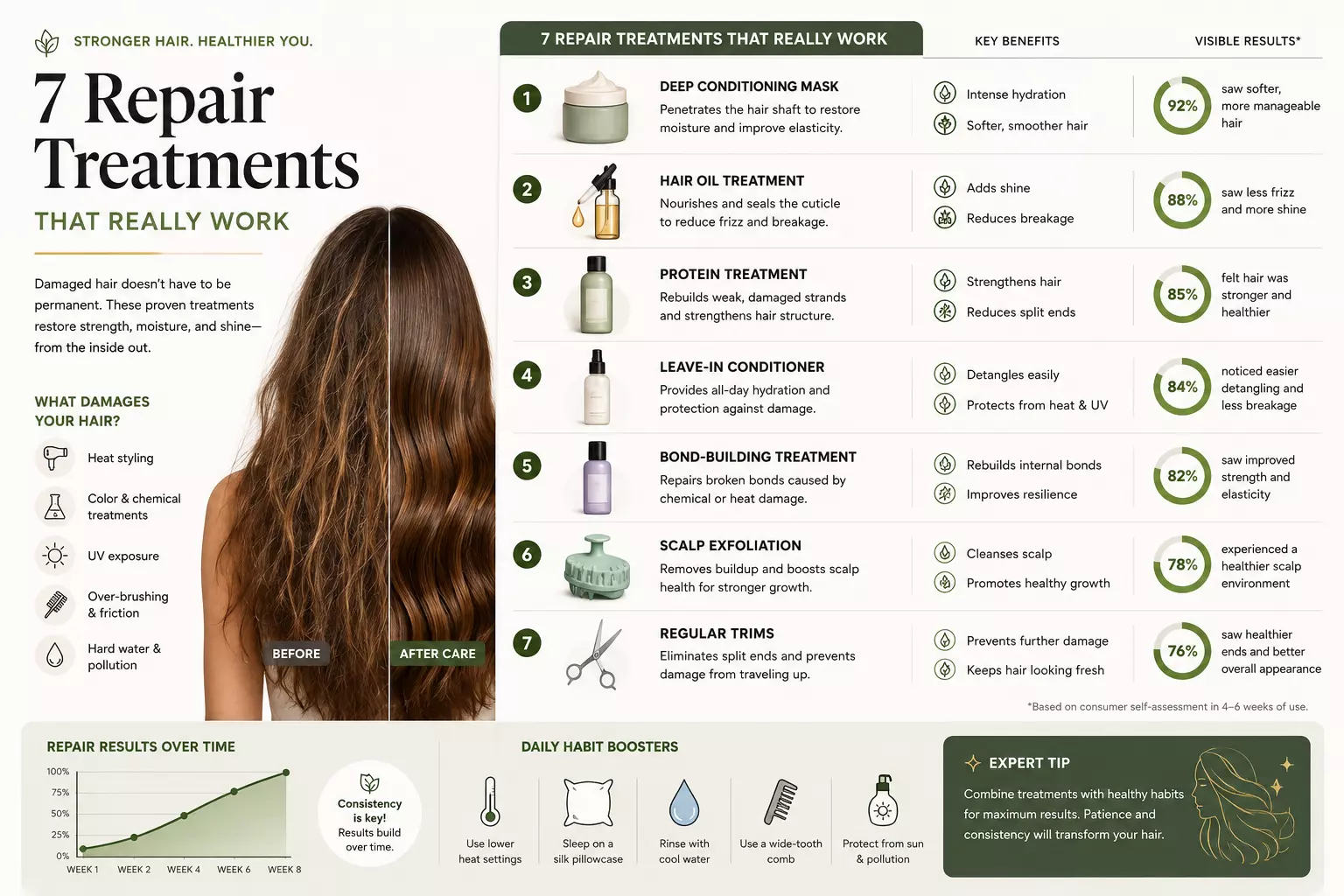
Let’s get into the treatments themselves. I’ve organized these from foundational to advanced, so you can build a repair routine that actually sticks.
Treatment 1: Deep Conditioning Masks 🧴
Deep conditioning masks are the cornerstone of any damaged hair repair routine. Unlike rinse-out conditioners, masks are formulated to penetrate the cortex and deliver moisture where it’s needed most.
What to look for:
- Shea butter — seals moisture and softens the cuticle
- Argan oil — rich in oleic acid and antioxidants
- Hydrolyzed keratin — fills gaps in the cortex
- Panthenol (Vitamin B5) — attracts and retains moisture
How to use it:
- Apply to clean, damp hair from mid-length to ends
- Cover with a shower cap and apply gentle heat (a warm towel works perfectly)
- Leave on for 20–30 minutes
- Rinse thoroughly with cool water to seal the cuticle
Frequency: Once per week for moderately damaged hair; twice weekly for severely damaged strands.
A friend of mine with heavily bleached hair swore by nothing but drugstore shampoo for years. After just three weeks of consistent deep conditioning, she noticed her hair snapping far less during styling. Small change, dramatic result.
Treatment 2: Protein Treatments 💪
If deep conditioning is about moisture, protein treatments are about structure. Hair is approximately 95% keratin protein. When that protein is depleted — through bleaching, heat, or mechanical stress — the strand becomes weak, gummy when wet, and prone to breakage.
Signs you need a protein treatment:
- Hair stretches excessively and doesn’t spring back
- Feels mushy or limp when wet
- Breaks easily even without tension
- Has lost its natural curl pattern
Types of protein treatments:
| Type | Best For | Strength |
|---|---|---|
| Hydrolyzed keratin | All damage types | Medium |
| Hydrolyzed wheat protein | Fine, limp hair | Light |
| Hydrolyzed silk protein | Shine and smoothness | Light |
| Rice water rinse | Strengthening and growth | Very light |
| Reconstructor treatment | Severe chemical damage | Heavy |
⚠️ Important: Do NOT overdo protein. Protein overload makes hair stiff, brittle, and prone to snapping. Always follow a protein treatment with a moisture-rich deep conditioner.
Frequency: Every 4–6 weeks for most hair types; monthly for fine or low-porosity hair.
Treatment 3: Bond-Building Treatments 🔬
This is where hair repair science has made its biggest leap in recent years. Bond-building treatments work at the molecular level, reconnecting broken disulfide bonds inside the cortex — the very bonds that bleach and chemical processing destroy.
The most well-known active ingredient in this category is bis-aminopropyl diglycol dimaleate (the active in Olaplex No. 3 and similar formulas). Other brands have developed their own bond-repair technologies using maleic acid, citric acid, and various amino acid complexes.
Why bond builders are different from regular treatments:
- They don’t just coat the hair — they repair internal structure
- Effects are cumulative with consistent use
- They can be used in-salon during chemical services to prevent damage in real time
How to use a bond-building treatment at home:
- Apply to clean, towel-dried hair
- Comb through from root to tip
- Leave on for a minimum of 10 minutes (longer for severe damage)
- Shampoo and condition as normal
💡 Pull Quote: “Bond builders changed the conversation around hair repair. For the first time, we could talk about actually fixing damage — not just masking it.”
Frequency: Weekly for damaged hair; every 2–3 weeks for maintenance.
Treatment 4: Scalp Treatments and Scalp Health 🌿
Here’s a treatment most people overlook entirely: your scalp. Healthy hair growth starts at the follicle, and a compromised scalp — whether dry, inflamed, or clogged with product buildup — directly impacts the quality of new hair coming in.
Key scalp issues that worsen hair damage:
- Product buildup — blocks follicles and disrupts the moisture balance
- Scalp dryness — leads to flaking and weakened hair at the root
- Inflammation — slows growth and weakens the follicle
- Sebum imbalance — either too oily or too dry affects strand health
Effective scalp treatments:
- Scalp scrubs (sugar or salt-based) — remove buildup and dead skin cells; use once every 1–2 weeks
- Salicylic acid scalp serums — address flaking and inflammation
- Peppermint or rosemary oil diluted in a carrier — stimulates circulation; research in 2026 continues to support rosemary oil’s effectiveness for hair density
- Clarifying shampoos — remove mineral and product buildup; use monthly
My personal experience: I used to skip scalp care entirely, focusing all my attention on my ends. Once I added a weekly scalp massage with diluted rosemary oil, I noticed new growth coming in noticeably thicker within about two months. The scalp is the soil — you can’t grow healthy hair in unhealthy ground.
Treatment 5: Keratin Smoothing Treatments 🌟
Keratin treatments are professional-grade smoothing services that infuse the hair shaft with keratin protein, then seal it in using heat. They dramatically reduce frizz, improve manageability, and add shine — all while reinforcing the hair’s protein structure.
Who benefits most:
- Frizzy, coarse, or chemically damaged hair
- Hair that has lost its smoothness from heat styling
- Anyone dealing with humidity-induced frizz
What to know before you go:
- Professional treatments typically last 3–5 months
- At-home keratin kits are available but less potent
- Some formulas contain formaldehyde or formaldehyde-releasing ingredients — ask your stylist specifically about the formula used
- Formaldehyde-free options are widely available in 2026 and perform well
Post-treatment care:
- Use sulfate-free shampoo to extend results
- Avoid chlorine and saltwater
- Wait 72 hours before washing hair after the treatment
Treatment 6: Hot Oil Treatments 🫒
Hot oil treatments are one of the oldest and most effective home remedies for damaged, dry hair — and the science backs them up. Certain plant oils are small enough to penetrate the hair shaft (rather than just coating it), delivering fatty acids directly to the cortex.
The best oils for damaged hair:
| Oil | Key Benefit | Hair Type |
|---|---|---|
| Coconut oil | Penetrates shaft, reduces protein loss | Thick, coarse, dry hair |
| Argan oil | Antioxidants, shine, frizz control | All types, especially color-treated |
| Castor oil | Strengthens, promotes growth | Thin, brittle, slow-growing hair |
| Jojoba oil | Mimics sebum, balances scalp | Oily scalp, fine hair |
| Olive oil | Deep moisture, softness | Very dry, coarse hair |
⚠️ Note: Coconut oil is not for everyone. If your hair feels stiff or dry after using it, you may have low-porosity hair — skip coconut oil and opt for lighter oils like argan or jojoba instead.
How to do a hot oil treatment at home:
- Warm 2–3 tablespoons of your chosen oil in a bowl of hot water (never microwave directly)
- Apply to dry hair, focusing on ends and damaged sections
- Massage into the scalp for 2–3 minutes
- Cover with a shower cap; apply gentle heat or wrap in a warm towel
- Leave on for 30–45 minutes
- Shampoo out thoroughly (may need two washes)
Frequency: Once every 1–2 weeks.
Treatment 7: Trimming and Strategic Hair Cuts ✂️
I know — this one isn’t technically a “treatment” in the product sense. But I’d be doing you a disservice if I left it off this list. No product, no matter how advanced, can repair a split end. Once the hair shaft splits, the only solution is to remove it. Leaving split ends untreated causes them to travel up the shaft, creating more damage over time.
Types of trims for damaged hair:
- Dusting — removes only the very tips (1/4 inch or less); ideal for length retention while eliminating splits
- Search and destroy — cutting individual split ends strand by strand; time-consuming but preserves length
- Traditional trim — removes 1/2 to 1 inch; the most effective for resetting damaged ends
- Big chop — removing significant length to start fresh; the fastest path to healthy hair
How often to trim:
- Healthy hair: every 8–12 weeks
- Moderately damaged: every 6–8 weeks
- Severely damaged: every 4–6 weeks until damage is eliminated
💡 Pull Quote: “Trimming isn’t giving up on length — it’s investing in the health of every inch you keep.”
How to Fix Damaged Hair: Building Your Complete Repair Routine
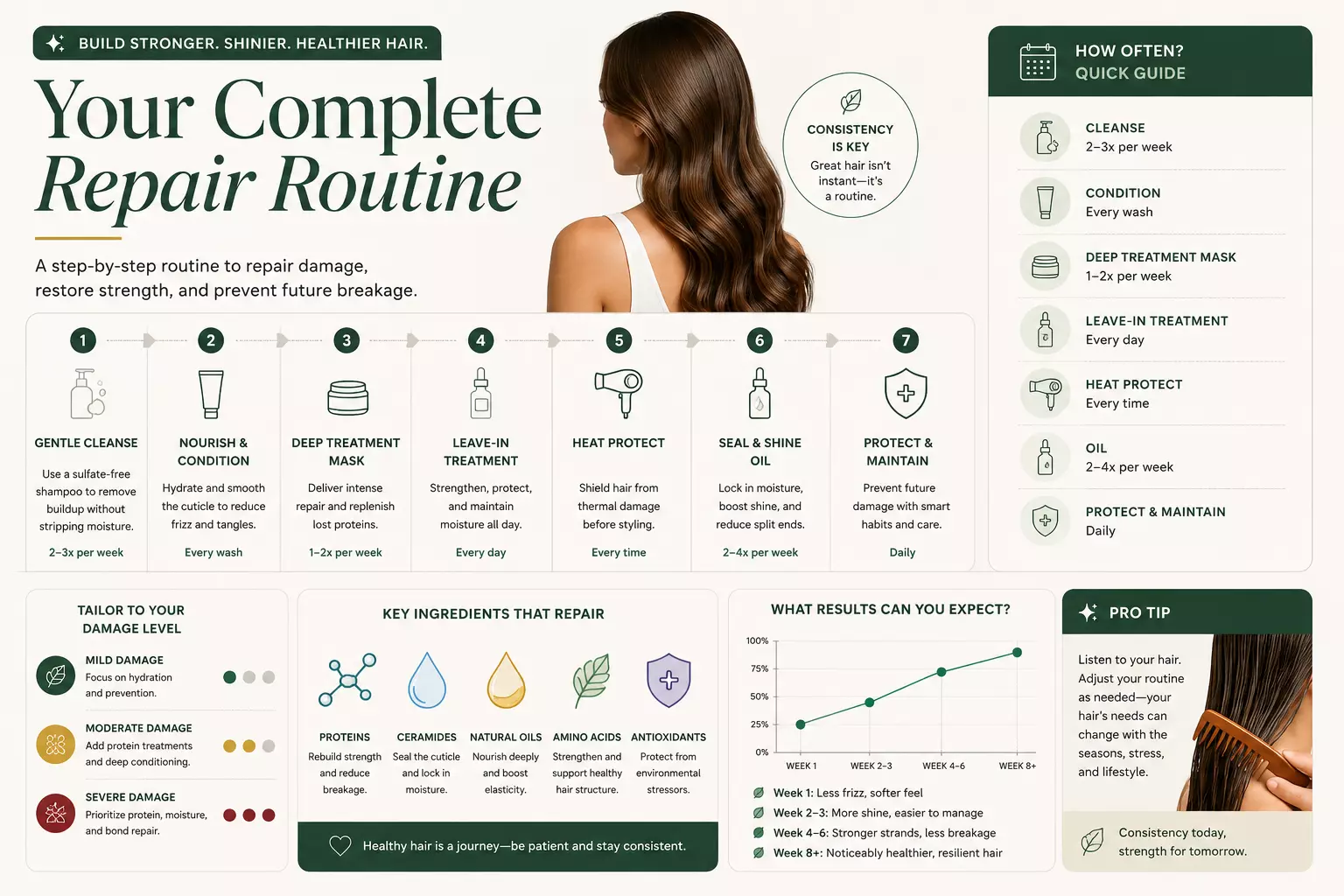
Now that you know the seven treatments, the key is combining them intelligently. Here’s a sample weekly routine for moderately damaged hair:
Weekly Repair Routine 📅
Sunday (Wash Day):
- Scalp scrub or clarifying shampoo (once monthly)
- Protein treatment OR deep conditioning mask (alternate weekly)
- Bond-building treatment (apply before shampooing)
- Hot oil treatment (apply before washing)
- Finish with a leave-in conditioner
Daily Habits:
- Apply a few drops of argan or jojoba oil to ends
- Use a wide-tooth comb on wet hair only
- Sleep on a satin or silk pillowcase
- Apply heat protectant before ANY heat styling
Monthly:
- Assess split ends and trim if needed
- Rotate in a keratin treatment (professional or at-home)
The Protein-Moisture Balance Rule
This is the single most important concept in damaged hair repair:
- Too much moisture → limp, mushy, over-elastic hair
- Too much protein → stiff, brittle, snapping hair
- The right balance → strong, elastic, healthy hair
A simple test: take a single strand and gently stretch it. Healthy hair stretches about 30% before snapping back. If it stretches too much and doesn’t return, you need protein. If it snaps immediately with no stretch, you need moisture.
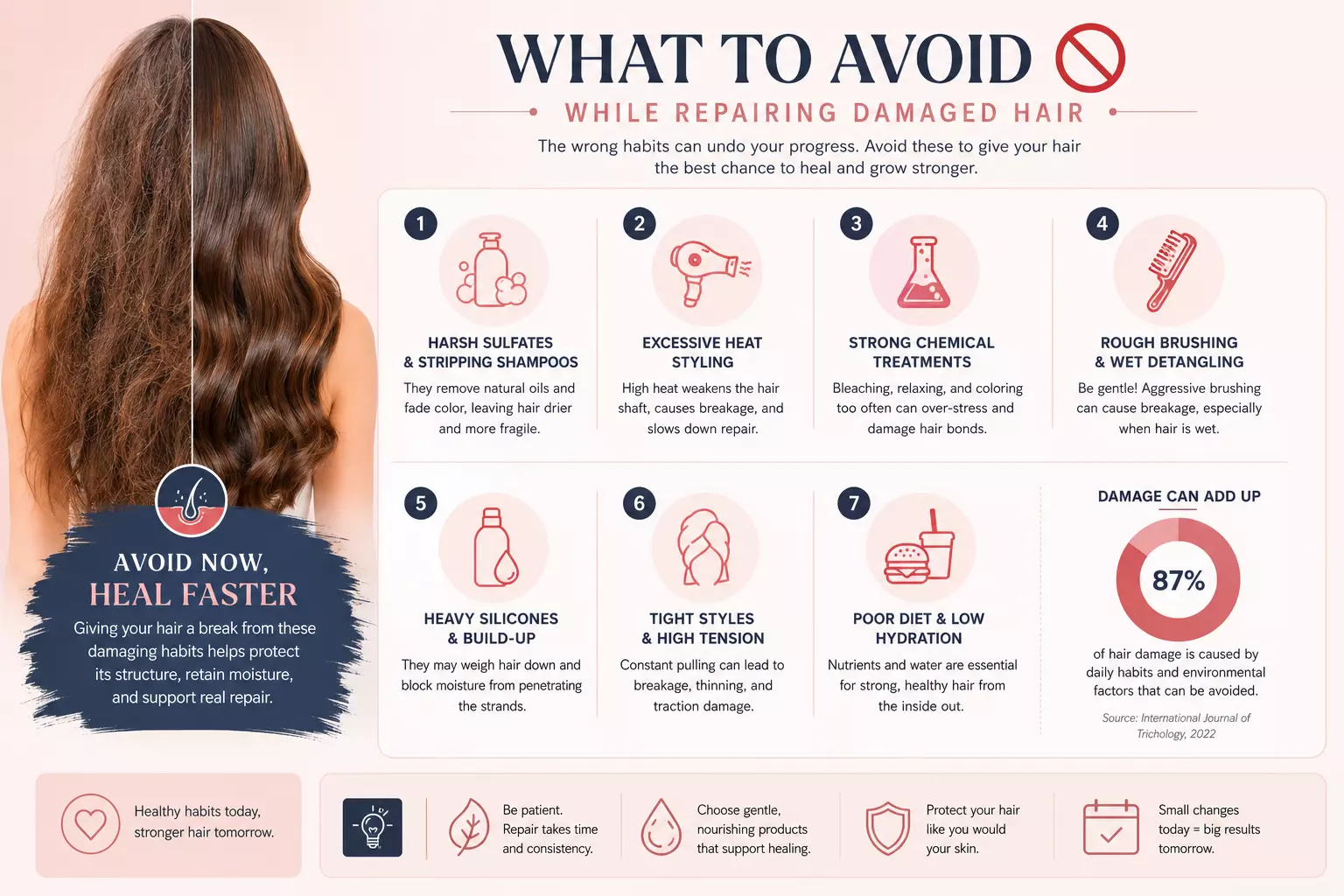
What to Avoid While Repairing Damaged Hair 🚫
Repairing damage is a two-step process: adding what’s missing AND stopping what’s causing harm.
Stop or significantly reduce:
- Heat styling above 350°F (175°C)
- Tight hairstyles that pull at the root (traction alopecia is real)
- Brushing hair aggressively when wet
- Overlapping bleach or chemical services on previously processed hair
- Skipping heat protectant
- Using terrycloth towels to dry hair (use a microfiber towel or cotton T-shirt instead)
- Washing with very hot water (cool or lukewarm is best)
Conclusion: Your Path to Healthier Hair Starts Now
Learning how to fix damaged hair: 7 repair treatments that really work isn’t about buying the most expensive products or following every trend. It’s about understanding what your hair actually needs — whether that’s moisture, protein, bond repair, scalp care, or simply a good trim — and delivering it consistently.
Your actionable next steps for 2026:
- ✅ Assess your damage type — is it heat, chemical, mechanical, or a combination?
- ✅ Do the stretch test to determine if you need protein or moisture first
- ✅ Start with one treatment — deep conditioning or bond-building — and stay consistent for 4 weeks before evaluating
- ✅ Book a trim if you haven’t had one in the last 8 weeks
- ✅ Audit your daily habits — heat protectant, pillowcase, and brushing technique matter more than most people realize
- ✅ Be patient — hair grows approximately half an inch per month; real repair takes time
The healthiest hair I’ve ever had came not from a single miracle product, but from a consistent, balanced routine built on understanding what my hair actually needed. You can get there too — one treatment at a time.