Biotin, Collagen, or Keratin? Which Supplement Actually Grows Hair
Nearly 50% of women and 85% of men will experience noticeable hair loss or thinning at some point in their lives — yet the supplement aisle has never been more crowded with promises. Walk into any pharmacy in 2026 and you’ll find shelves stacked with biotin gummies, marine collagen powders, and keratin capsules, each claiming to be the secret to thicker, longer, shinier hair. But which one actually works?
The question of Biotin, Collagen, or Keratin? Which Supplement Actually Grows Hair is one I’ve been asked more times than I can count — by friends, readers, and even my own family members who’ve tried every trending supplement only to feel confused and disappointed. The truth is more nuanced than any marketing label will tell you. Let me break it all down with science, honesty, and practical guidance.
Key Takeaways 🔑
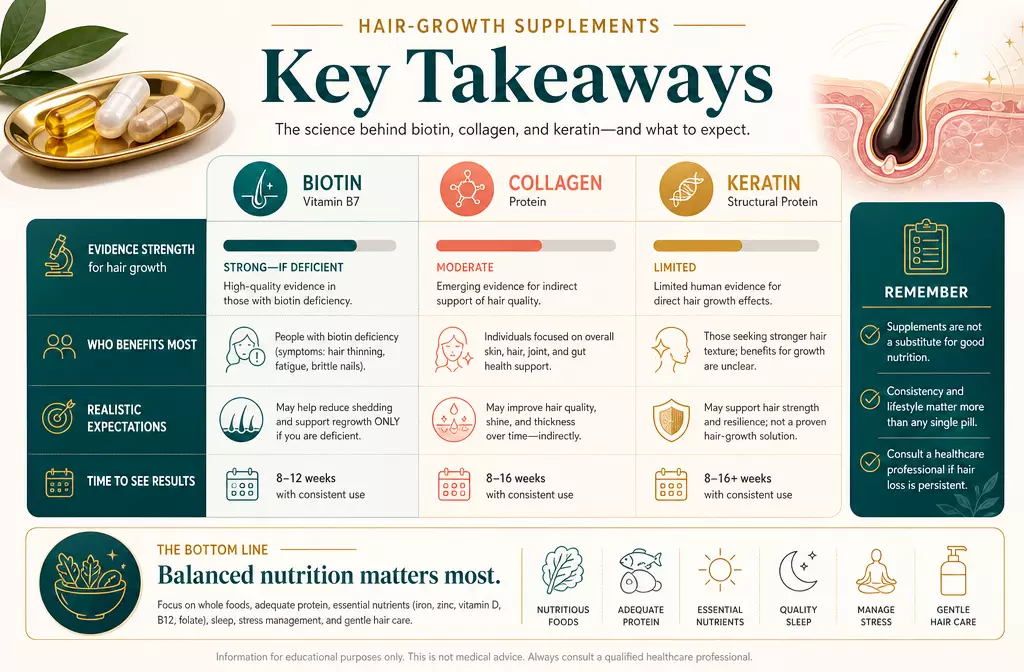
- Biotin is the most researched hair supplement, but deficiency is rare — most people see limited results unless they’re actually deficient.
- Collagen supports the scalp environment and provides amino acids that can indirectly support hair growth, making it a strong contender.
- Keratin supplements are largely broken down during digestion and may not deliver intact protein to hair follicles.
- Diet and underlying health conditions matter far more than any single supplement.
- Combining approaches — nutrition, scalp health, and targeted supplementation — yields the best real-world results.
- Try our Free Interactive app: Find Your Perfect Hair Supplement Match with Our Interactive Quiz
Disclosure: This post contains affiliate links. As an Amazon Associate, we earn from qualifying purchases, and at no extra cost to you.
Understanding How Hair Actually Grows
Before we tackle Biotin, Collagen, or Keratin? Which Supplement Actually Grows Hair, it’s worth understanding what hair actually needs to grow in the first place.
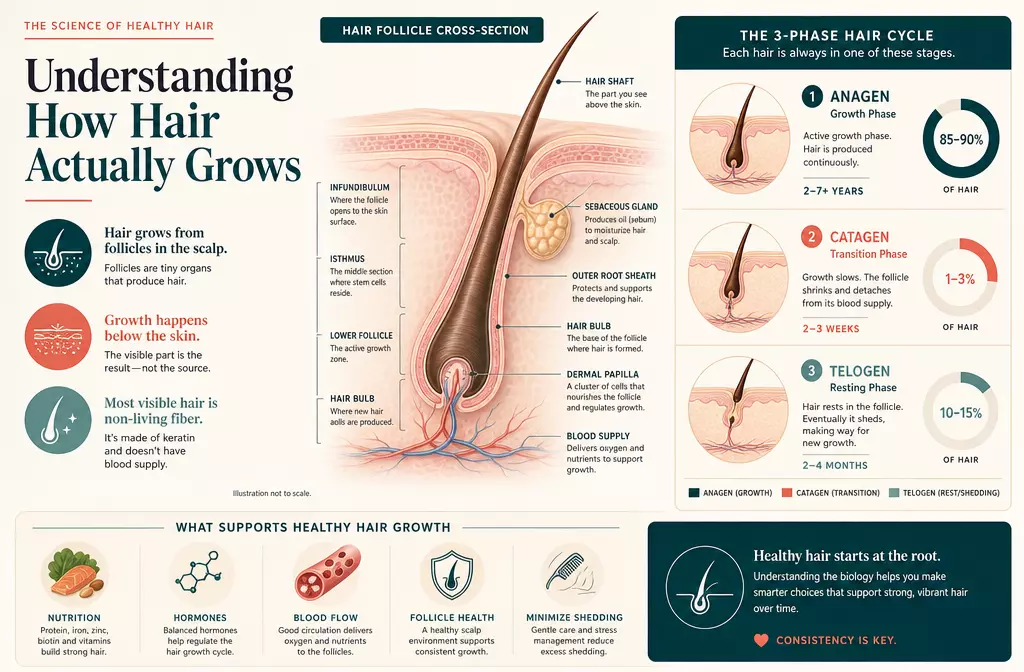
Hair growth happens in cycles — the anagen (growth) phase, the catagen (transition) phase, and the telogen (resting/shedding) phase. At any given time, roughly 85–90% of your hair is in the anagen phase, which can last 2–7 years. The quality of that growth depends heavily on:
- Nutrient availability (vitamins, minerals, amino acids)
- Scalp circulation and health
- Hormonal balance
- Oxidative stress levels
- Genetics
Hair is made primarily of a protein called keratin, which is built from amino acids. The follicle — the tiny structure in your scalp that produces each strand — is one of the most metabolically active tissues in the body. That means it has a high demand for nutrients.
💡 Pull Quote: “The hair follicle is essentially a tiny factory that runs 24/7. Feed it poorly, and production slows down.”
Understanding this foundation helps us evaluate each supplement category fairly and scientifically.
Biotin: The Most Famous Hair Supplement
What Is Biotin?
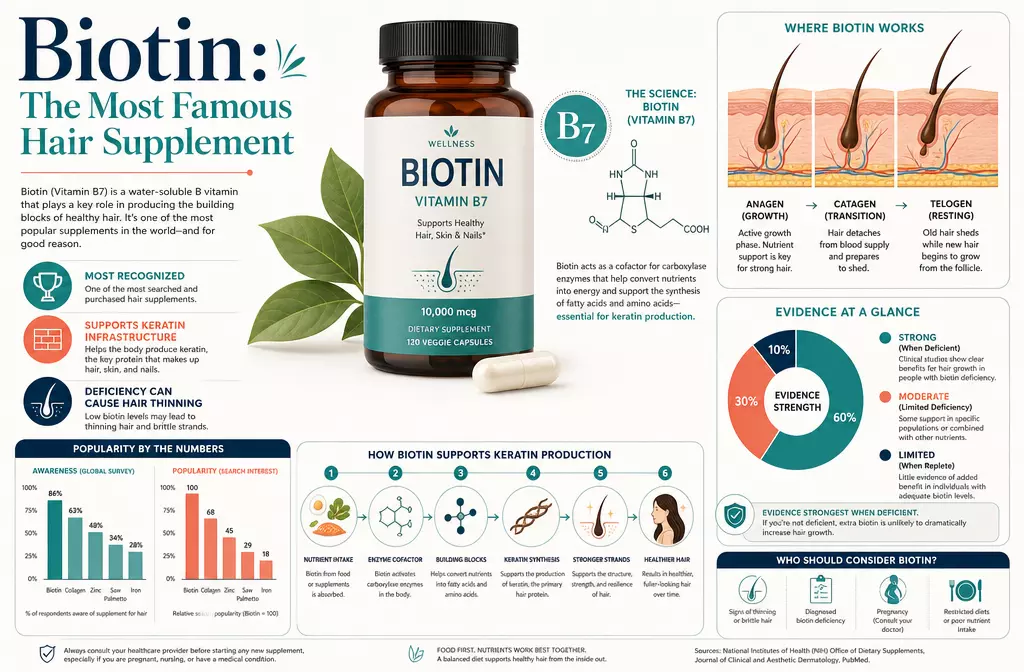
Biotin, also known as Vitamin B7, is a water-soluble B vitamin that plays a critical role in the metabolism of fats, carbohydrates, and proteins. It’s essential for the production of keratin — the very protein your hair is made of.
The Science Behind Biotin and Hair Growth
Biotin deficiency is well-documented to cause hair loss, brittle nails, and skin rashes. In clinical studies, people with confirmed biotin deficiency who were supplemented showed clear improvements in hair growth and quality.
Here’s the catch: True biotin deficiency is actually quite rare in healthy adults eating a varied diet. Most people consuming eggs, nuts, seeds, salmon, and leafy greens get adequate biotin naturally.
A landmark review published in the Journal of Clinical and Aesthetic Dermatology found that in all reported cases of biotin supplementation improving hair and nail health, there was an underlying deficiency or condition causing poor absorption.
| Biotin Fact | Detail |
|---|---|
| Daily Recommended Intake | 30 mcg/day for adults |
| Common Supplement Dose | 2,500–10,000 mcg/day |
| Evidence for Non-Deficient Users | Limited |
| Evidence for Deficient Users | Strong |
| Safety | Generally safe (water-soluble) |
| Lab Test Interference | ⚠️ High doses can skew thyroid and cardiac lab results |
Who Should Take Biotin?
✅ People with biotin deficiency (often caused by prolonged antibiotic use, pregnancy, or certain genetic disorders)
✅ Those on restrictive diets
✅ Individuals with biotinidase deficiency (a rare metabolic condition)
❌ Healthy adults with a balanced diet likely won’t see dramatic results
My honest take: Biotin is safe, affordable, and worth trying — but don’t expect miracles if your diet is already solid. And always tell your doctor if you’re taking high-dose biotin before bloodwork.
Collagen: The Underrated Contender
What Is Collagen?
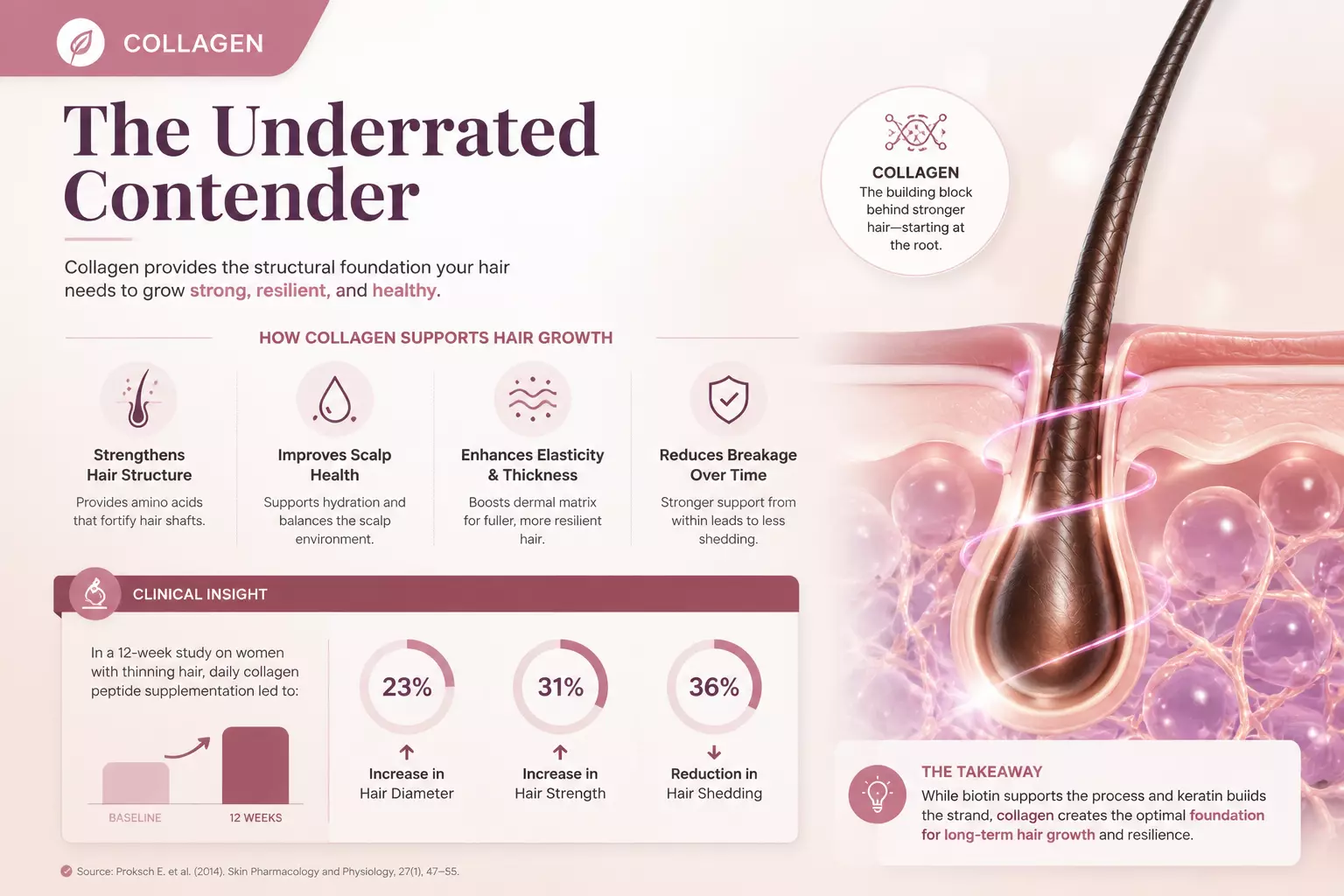
Collagen is the most abundant protein in the human body. It forms the structural scaffolding of skin, bones, tendons, and — critically — the dermis of the scalp, where hair follicles are anchored.
There are several types of collagen, but Type I and Type III are most relevant to hair health. Marine collagen (from fish) and bovine collagen (from cattle) are the most common supplement sources.
How Collagen Supports Hair Growth
Collagen doesn’t directly build hair the way keratin does. Instead, it works through several indirect but powerful mechanisms:
- Provides amino acids for keratin synthesis — Collagen is rich in proline, glycine, and hydroxyproline. Proline, in particular, is a precursor to the amino acids used to build keratin.
- Supports the dermal papilla — The dermal papilla is a cluster of cells at the base of each follicle that signals hair growth. Collagen helps maintain the extracellular matrix that keeps these cells healthy.
- Antioxidant activity — Some research suggests collagen peptides may help neutralize free radicals that damage follicles.
- Scalp skin elasticity — A healthier, more elastic scalp supports better follicle function and circulation.
💡 Pull Quote: “Collagen doesn’t grow your hair directly — it builds the environment in which great hair growth becomes possible.”
What the Research Says
Several double-blind, placebo-controlled studies have shown that hydrolyzed collagen supplementation (broken down into peptides for better absorption) can improve hair thickness, reduce shedding, and increase the proportion of hair in the anagen phase.
A notable study found that women who took a specific collagen peptide supplement for 6 months experienced a significant increase in hair volume and scalp coverage compared to the placebo group.
Collagen vs. Biotin: A Quick Comparison
| Factor | Biotin | Collagen |
|---|---|---|
| Mechanism | Keratin synthesis cofactor | Amino acid supply + scalp support |
| Direct hair building | Indirect (metabolic) | Indirect (structural support) |
| Evidence quality | Moderate (deficiency-dependent) | Growing (especially hydrolyzed) |
| Best form | Capsule or gummy | Hydrolyzed powder or capsule |
| Absorption | High | High (when hydrolyzed) |
| Side effects | Lab interference at high doses | Minimal |
Keratin Supplements: Do They Actually Work?
The Keratin Paradox
Here’s where things get interesting — and a little counterintuitive. Since hair is made of keratin, it seems logical that taking keratin supplements would directly feed your hair. Right?
Not exactly.
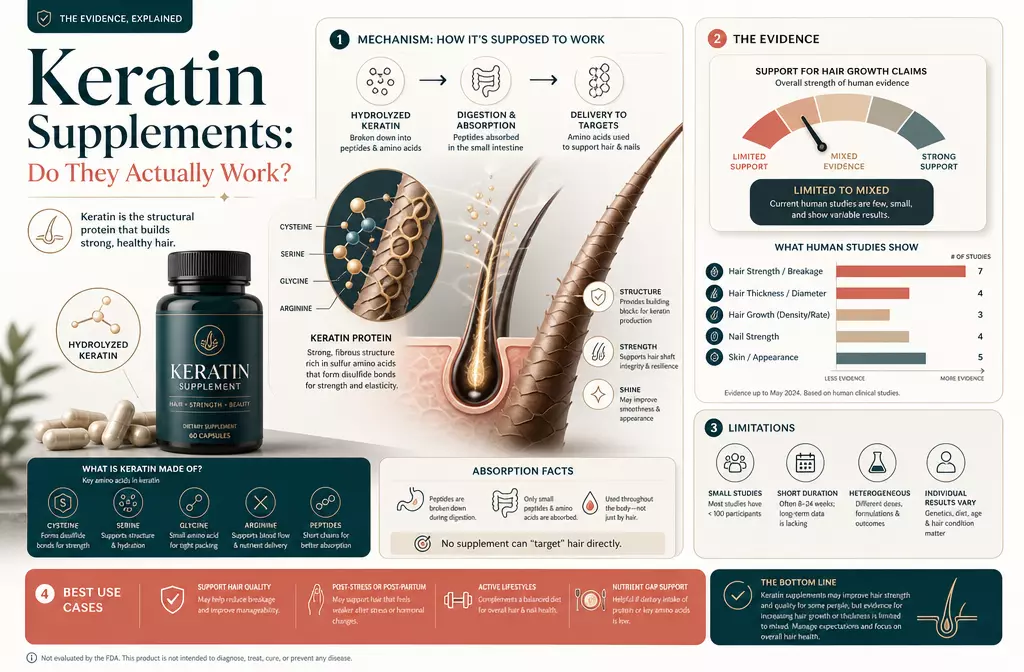
When you swallow a keratin supplement, your digestive system does what it does with all proteins: it breaks them down into individual amino acids. By the time those amino acids enter your bloodstream, they’ve lost their keratin structure entirely. Your body then uses those amino acids as raw materials for whatever it needs most — which may or may not be hair.
Keratin Supplements vs. Keratin Treatments
It’s important to distinguish between:
- Keratin supplements (taken orally) — provide amino acids
- Keratin hair treatments (applied topically) — temporarily smooth and coat the hair shaft
Topical keratin treatments (like the popular salon smoothing treatments) can make hair look healthier and more manageable, but they don’t stimulate growth or repair the follicle. They’re cosmetic, not therapeutic.
Is There Any Value in Keratin Supplements?
Some keratin supplements use a form called hydrolyzed keratin or a patented ingredient like Cynatine® HNS, which is derived from solubilized keratin. Early research on these specific forms suggests they may be absorbed more efficiently and show some benefit for hair strength and reduced breakage.
However, the evidence is still early-stage and often funded by the manufacturers themselves — a significant limitation to keep in mind.
| Keratin Supplement Type | Absorption | Evidence Level |
|---|---|---|
| Standard keratin protein | Low (digested) | Weak |
| Hydrolyzed keratin | Moderate | Limited but promising |
| Cynatine® HNS (solubilized) | Higher | Early-stage, industry-funded |
Bottom line on keratin supplements: They’re not useless, but they’re the weakest of the three when it comes to direct hair growth evidence. You’d likely get similar amino acid benefits from a quality protein powder at a fraction of the cost.
The Real Answer: Biotin, Collagen, or Keratin? Which Supplement Actually Grows Hair
Let me be direct here: no single supplement is a guaranteed hair growth solution for everyone. The answer to Biotin, Collagen, or Keratin? Which Supplement Actually Grows Hair depends entirely on why your hair is struggling in the first place.
Here’s a practical framework:
🧬 If You Suspect Nutritional Deficiency → Start with Biotin (+ Iron, Zinc, D3)
Hair loss from deficiency responds best to addressing the specific deficiency. Before spending money on any supplement, consider getting a blood panel that checks:
- Biotin levels (rarely tested but available)
- Ferritin (iron stores) — one of the most common hidden causes of hair loss
- Vitamin D
- Zinc
- Thyroid hormones (TSH, T3, T4)
🌿 If You Want Overall Scalp and Hair Health Support → Choose Collagen
Collagen is my top recommendation for most people because it supports multiple pathways simultaneously — amino acid supply, scalp health, and antioxidant protection. Hydrolyzed marine collagen is particularly well-absorbed.
💪 If You Want Stronger, Less Breakage-Prone Hair → Consider Keratin (Hydrolyzed Form)
If your issue is breakage and brittleness rather than actual growth, a hydrolyzed keratin supplement may help reduce mechanical damage and improve hair tensile strength.
The Power of Combining Supplements
Many people find the best results from a stack approach:
| Goal | Recommended Stack |
|---|---|
| Thinning + slow growth | Collagen + Biotin + Iron |
| Breakage + brittleness | Hydrolyzed Keratin + Collagen |
| General maintenance | Collagen + Vitamin D |
| Post-partum shedding | Biotin + Iron + Zinc |
⚠️ Important: Always consult a dermatologist or trichologist before starting a supplement regimen, especially if you’re experiencing significant hair loss. Supplements won’t fix hormonal causes, autoimmune conditions (like alopecia areata), or severe nutritional deficiencies without proper medical guidance.
What Actually Makes the Biggest Difference for Hair Growth
I’d be doing you a disservice if I only talked about supplements without addressing the bigger picture. Here’s what the research consistently shows matters most:
1. Protein Intake 🥩
Hair is protein. If you’re not eating enough protein (at least 0.8g per kg of body weight, ideally more if active), no supplement will compensate. Prioritize whole food protein sources: eggs, fish, chicken, legumes, Greek yogurt.
2. Scalp Health 🧴
A healthy scalp is the foundation of healthy hair. Chronic inflammation, dandruff, seborrheic dermatitis, and poor circulation all impair follicle function. Regular scalp massage (even 4 minutes daily) has been shown in small studies to increase hair thickness over time.
3. Stress Management 🧘
Chronic stress triggers telogen effluvium — a condition where large numbers of follicles simultaneously enter the resting/shedding phase. This is one of the most common causes of sudden hair loss, and no supplement will fix it without also addressing the stress itself.
4. Hormonal Balance ⚖️
Androgenetic alopecia (pattern hair loss) is driven by DHT (dihydrotestosterone). Supplements don’t block DHT. If this is your issue, you need to speak with a doctor about clinically proven options like minoxidil or finasteride.
5. Sleep and Recovery 😴
Growth hormone — which supports tissue repair including hair follicles — is primarily released during deep sleep. Chronic poor sleep is a silent saboteur of hair health.
Choosing the Right Supplement: What to Look For in 2026
The supplement market in 2026 is more sophisticated than ever — but so is the marketing. Here’s how to evaluate any hair supplement:
🔍 Quality Markers to Check
- Third-party testing: Look for NSF Certified, USP Verified, or Informed Sport logos
- Hydrolyzed forms: For collagen and keratin, hydrolyzed versions are better absorbed
- Clinically studied doses: Biotin at 2,500–5,000 mcg; collagen at 2.5–10g daily
- Transparent labeling: Avoid “proprietary blends” that hide individual ingredient amounts
- Minimal fillers: Check for unnecessary additives, artificial colors, and allergens
🚩 Red Flags to Avoid
- Claims of “clinically proven” results without accessible published research
- Extremely high doses (10,000+ mcg biotin without medical reason)
- Products that promise results in “7 days” or “2 weeks”
- No mention of third-party testing
Conclusion: The Verdict on Biotin, Collagen, or Keratin? Which Supplement Actually Grows Hair
After reviewing the science, the marketing, and the real-world experiences of thousands of people, here’s my honest verdict:
🥇 Best overall for hair health: Hydrolyzed Collagen
It supports the most pathways, has growing clinical evidence, and benefits extend beyond just hair to skin and joints.
🥈 Best for deficiency-related hair loss: Biotin
If you’re deficient or have a condition affecting B vitamin absorption, biotin can make a meaningful difference.
🥉 Best for reducing breakage: Hydrolyzed Keratin
If your hair grows but breaks before it gets long, a quality hydrolyzed keratin product may help.
Your Actionable Next Steps 📋
- Get bloodwork done — check ferritin, Vitamin D, thyroid, and zinc before spending money on supplements
- Audit your protein intake — aim for 80–100g of protein daily from whole foods
- Start with collagen — 5–10g of hydrolyzed marine collagen daily is a low-risk, evidence-backed starting point
- Add biotin if deficient — 2,500–5,000 mcg is a reasonable dose; inform your doctor
- Give it time — hair grows slowly. Expect to evaluate results after 3–6 months minimum
- See a dermatologist if hair loss is sudden, patchy, or significant — supplements are not a substitute for medical evaluation
The truth about Biotin, Collagen, or Keratin? Which Supplement Actually Grows Hair isn’t a single magic pill. It’s a combination of the right supplement for your specific situation, a nutrient-rich diet, a healthy scalp, and enough patience to let biology do its work.
Your hair is worth the investment — just make sure that investment is an informed one.