Scalp Massage for Hair Growth: A 5-Minute Daily Tutorial
A single clinical trial changed how thousands of people think about their morning routine: nine men massaged their scalps for just four minutes a day, and after 24 weeks, measurable increases in hair shaft thickness appeared — with no drugs, no surgery, and no special diet [7]. That small but compelling finding sparked a wave of interest in scalp massage for hair growth, and in 2026, it remains one of the most accessible, low-cost hair care habits you can build. This guide — your complete Scalp Massage for Hair Growth: A 5-Minute Daily Tutorial — breaks down the science, the technique, and the tools so you can start today with confidence.
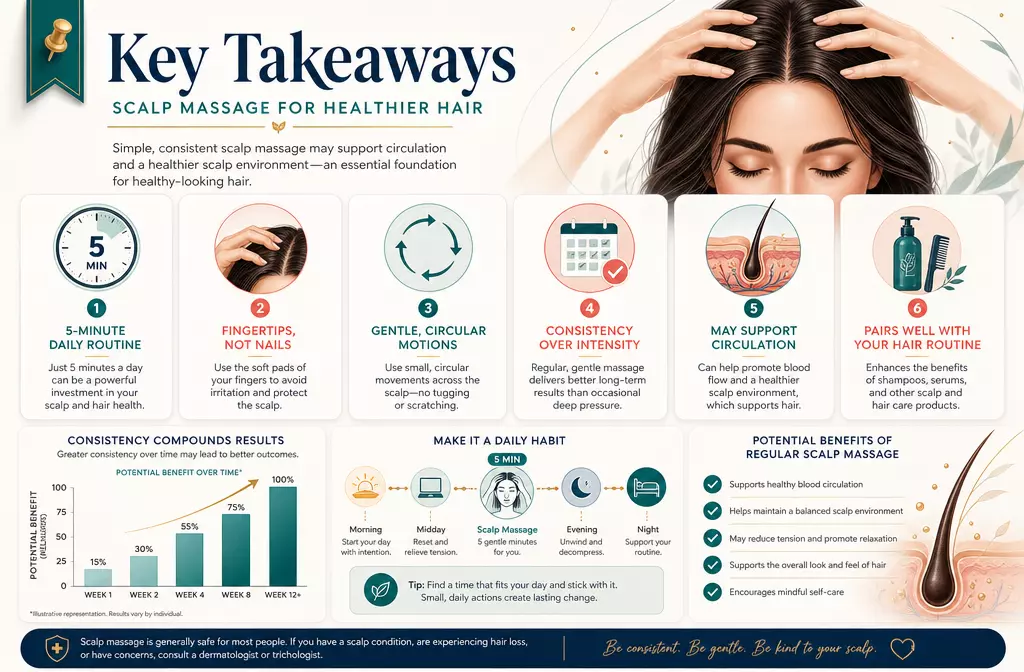
Key Takeaways 📌
- Daily scalp massage can increase hair shaft thickness and may help stabilize hair loss, based on small but consistent clinical evidence [7].
- Five minutes per day is a realistic starting point, especially when paired with shampooing or serum application.
- Fingertips, not fingernails — technique matters more than pressure or duration.
- Results take time: expect at least 3–6 months of consistency before visible changes appear [1].
- Scalp massage is a complement to other treatments, not a standalone cure for significant hair loss [2].
Disclosure: This post contains affiliate links. As an Amazon Associate, we earn from qualifying purchases, and at no extra cost to you.
The Science Behind Scalp Massage and Hair Growth
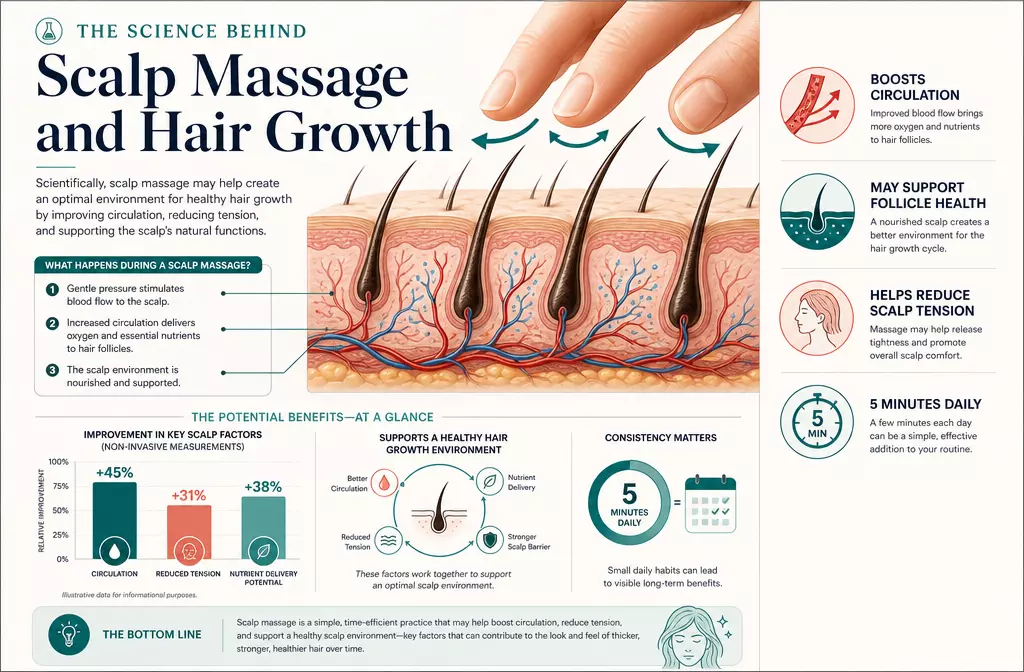
Before diving into the tutorial itself, it helps to understand why this works — or at least, why researchers think it might.
What the Research Actually Shows
The most-cited clinical study on this topic is a 2016 Japanese pilot published in ePlasty. Nine healthy men with no active hair loss used a standardized scalp massage device for four minutes daily over 24 weeks. Researchers measured hair shaft thickness before and after and found a statistically significant increase — roughly 0.18–0.27 micrometers — in the massaged area compared to the control side. Importantly, hair count and growth rate did not change significantly. Only shaft thickness improved [7].
💬 Pull Quote: “Even a four-minute daily protocol produced measurable changes in hair shaft diameter after six months — suggesting consistency matters more than session length.” — Based on findings from PMC4740347 [7]
A broader review of the evidence, including a study in androgenetic alopecia (the most common form of pattern hair loss), found that approximately 70% of participants who massaged their scalps for 20 minutes daily showed either stabilization or some degree of regrowth over several months [5]. However, experts consistently emphasize these were small, low-powered studies — not large randomized controlled trials [2].
The Proposed Mechanisms
Researchers and dermatologists have proposed several explanations for why scalp massage might support hair growth:
| Mechanism | What It Means | Evidence Level |
|---|---|---|
| Mechanical stretching | Fingertip pressure stretches dermal papilla cells, potentially altering gene expression related to the hair growth cycle | Moderate (lab + clinical) [7] |
| Increased blood flow | Massage may boost circulation, delivering more oxygen and nutrients to follicles | Plausible, not fully proven [2] |
| Stress reduction | Lower cortisol levels may reduce stress-related hair shedding (telogen effluvium) | Theoretical [5] |
| Sebum distribution | Massage may spread natural scalp oils along the hair shaft, improving condition | Anecdotal |
None of these mechanisms are fully proven. But the combination of plausibility and real (if modest) clinical results makes scalp massage worth incorporating into a daily routine [2].
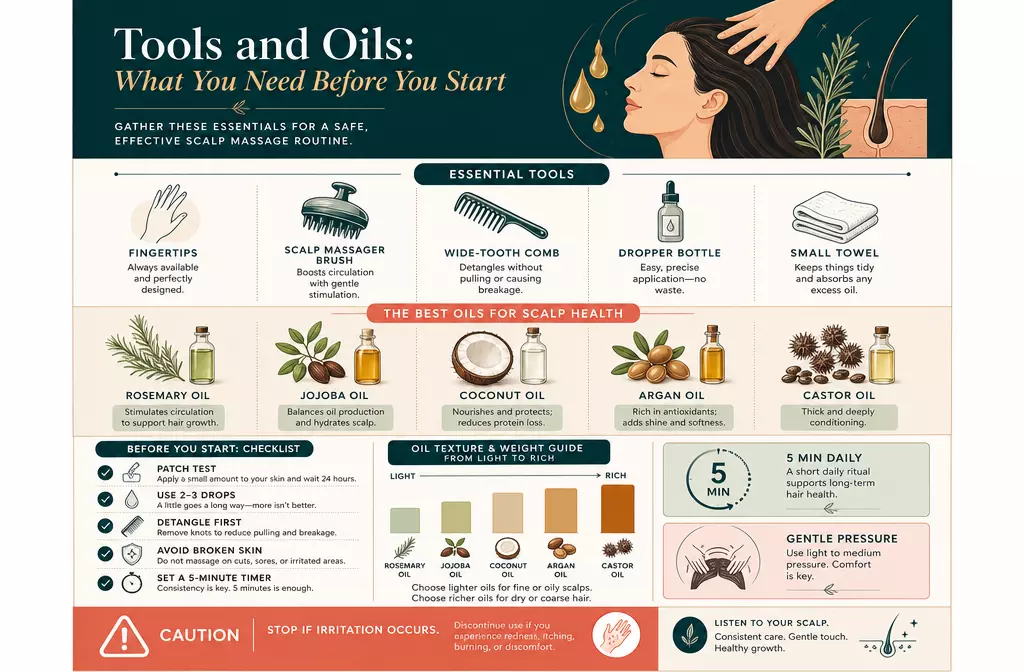
Tools and Oils: What You Need Before You Start
One of the best things about this practice is that you need almost nothing to begin. Your fingertips are the most effective tool available.
Option 1: Bare Fingertips (Recommended for Beginners)
The 2016 clinical trial used a specialized device, but most dermatologists and hair care educators recommend starting with your fingertips. They offer the most control, the most sensitivity, and zero cost [8].
What to avoid: Never use your fingernails. Scratching the scalp can cause micro-abrasions, inflammation, and potentially worsen hair loss.
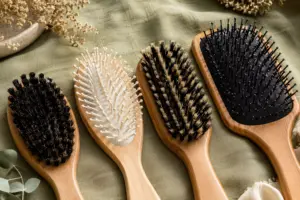
Option 2: Scalp Massage Devices
Handheld scalp massagers — typically made of silicone or stainless steel — are widely available and can make the process easier, especially for people with limited hand mobility. Look for:
- ✅ Soft, rounded silicone tips
- ✅ Ergonomic grip
- ✅ Easy to clean
- ❌ Avoid stiff metal bristles
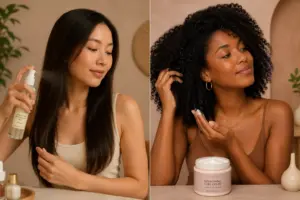
Option 3: Massage Oils (Optional but Beneficial)
You don’t need oil, but adding one can enhance the experience and potentially deliver additional benefits. Popular choices include:
- Rosemary oil — The most evidence-backed option; one small study found it comparable to minoxidil 2% for hair density improvement [2]
- Peppermint oil — Diluted in a carrier oil; some early research suggests it may stimulate follicles
- Jojoba or argan oil — Excellent carrier oils that condition the scalp without clogging pores
⚠️ Important: Always dilute essential oils in a carrier oil (1–2 drops per teaspoon of carrier). Never apply undiluted essential oils directly to the scalp.
Scalp Massage for Hair Growth: A 5-Minute Daily Tutorial (Step-by-Step)
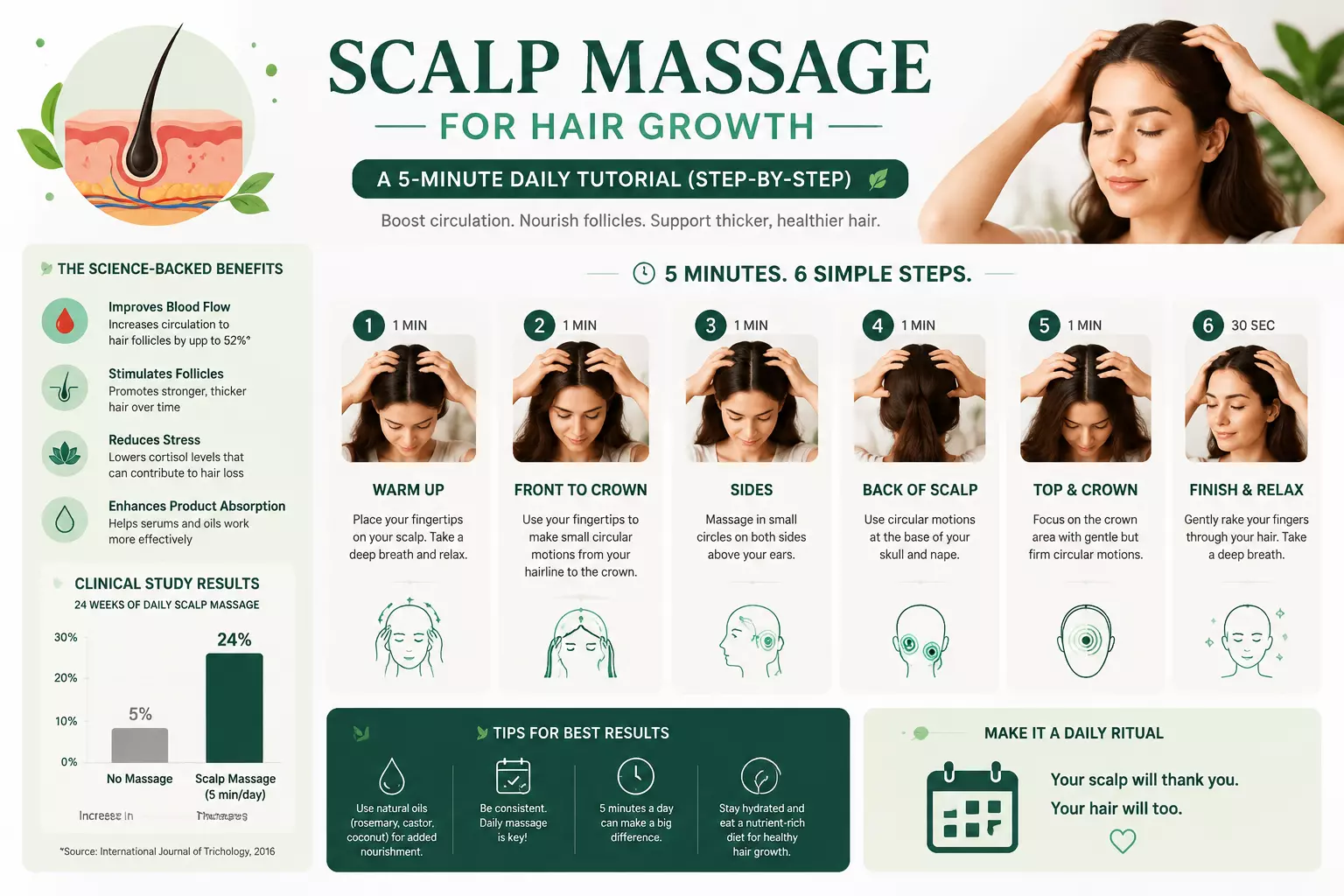
This is the core of your Scalp Massage for Hair Growth: A 5-Minute Daily Tutorial. I’ve broken it into five one-minute segments so you can follow along with a simple timer. The technique is based on the clinical protocols reviewed in the research literature and adapted for daily home use [7][8].
⏱️ Minute 1: The Temples and Hairline (0:00–1:00)
Starting position: Place all ten fingertips along your hairline — thumbs near your ears, index fingers at the temples, remaining fingers spread toward the top of your forehead.
Motion: Apply firm but gentle pressure (think: the pressure you’d use to knead bread dough, not press a bruise). Make slow, circular movements — about 1–2 circles per second.
Coverage: Work from the hairline inward about one inch. This zone is often neglected but is critical for frontal hair density.
Tip: Keep your scalp moving under your fingertips — don’t slide your fingers across the scalp surface. The goal is to move the skin, not scrub it.
⏱️ Minute 2: The Crown (1:00–2:00)
Starting position: Move both hands to the top of your head, fingertips spread wide.
Motion: Use the same circular kneading motion, but cover a wider area. Think of dividing your crown into four quadrants and spending about 15 seconds on each.
Why this zone matters: The crown is the most common area for androgenetic hair thinning in both men and women. Consistent massage here may help with the stabilization effects noted in clinical observations [5].
⏱️ Minute 3: The Sides (2:00–3:00)
Starting position: Place one hand on each side of your head, fingertips pointing upward just above the ears.
Motion: Work in upward-sweeping circular motions from just above the ear toward the crown. Spend 30 seconds on each side.
Bonus: This is a great zone for relieving tension headaches — a pleasant side effect of the practice.
⏱️ Minute 4: The Nape and Back (3:00–4:00)
Starting position: Tilt your head slightly forward. Place both hands at the nape of your neck, fingertips pointing upward.
Motion: Work in upward kneading motions from the nape toward the crown. This area has dense blood vessel networks and is often missed in casual scalp routines.
Feel for: Tension knots or tight spots — these are common in people who spend long hours at a desk and may indicate areas of reduced circulation.
⏱️ Minute 5: Full Scalp Integration (4:00–5:00)
Starting position: Spread all ten fingertips across your entire scalp.
Motion: Perform a slow, full-scalp compression — press gently inward and hold for 3 seconds, release, then shift position slightly and repeat. Cover the entire scalp in 3–4 compressions.
Finish: End with a gentle scalp “shake” — place both hands flat on your head and vibrate your fingertips rapidly for 10–15 seconds. This is purely anecdotal, but many people find it leaves the scalp feeling warm and energized.
📋 Quick Reference: 5-Minute Scalp Massage Routine
| Minute | Zone | Technique |
|---|---|---|
| 1 | Temples & Hairline | Circular kneading, inward pressure |
| 2 | Crown | Wide circular coverage, 4 quadrants |
| 3 | Sides (above ears) | Upward sweeping circles |
| 4 | Nape & Back | Upward kneading from neck to crown |
| 5 | Full scalp | Compression holds + vibration finish |
How Often, How Long, and When to Expect Results
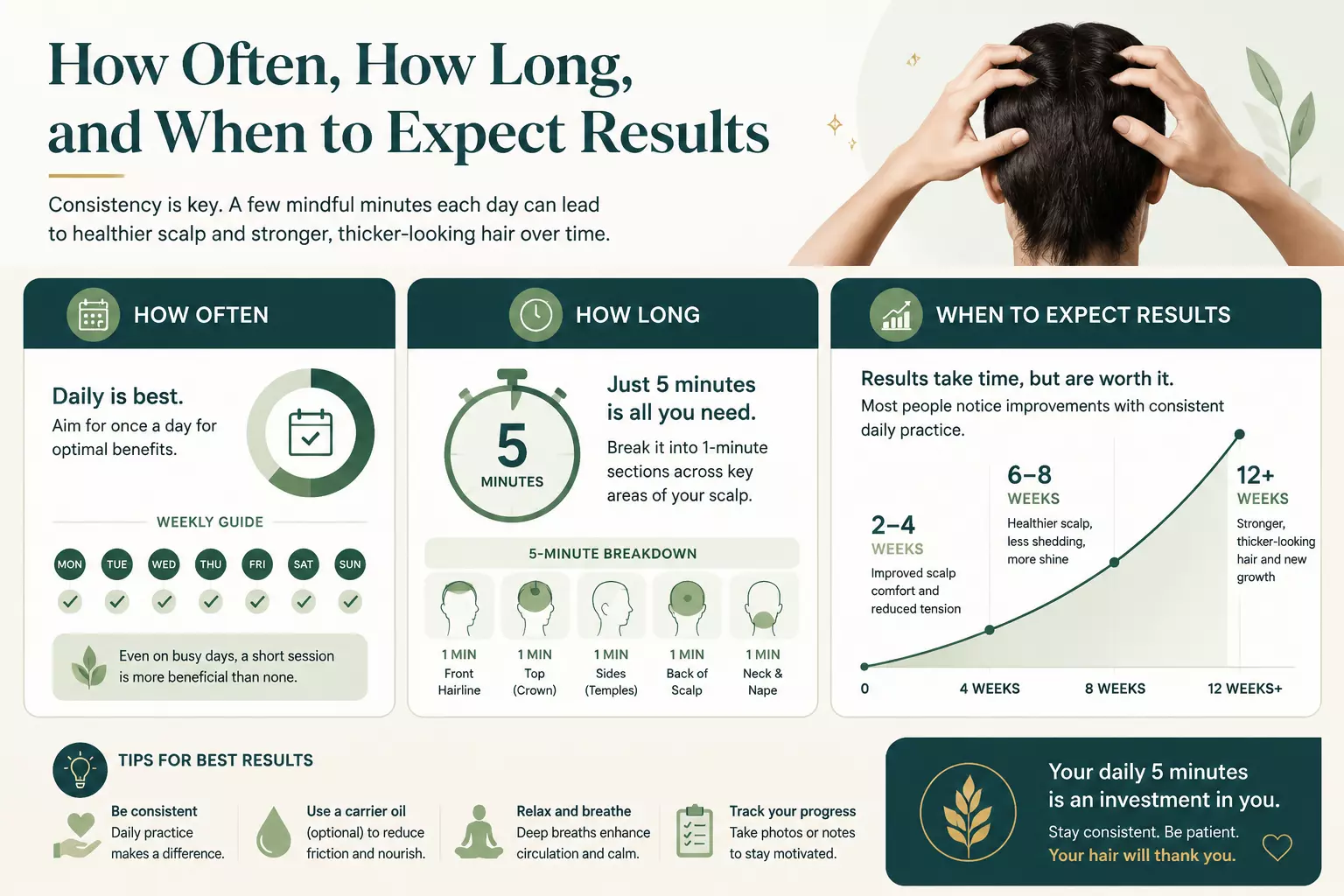
Frequency: Daily Is the Goal
The research protocols that showed results used daily massage — not three times a week, not “when I remember.” The 2016 study used four minutes every single day for 24 weeks [7]. Consistency is the active ingredient here.
That said, if you miss a day, don’t stress about it. Stress-induced hair loss (telogen effluvium) is real, and guilt-tripping yourself over a missed session defeats the purpose.
Duration: Building Up Over Time
| Phase | Duration | Goal |
|---|---|---|
| Weeks 1–4 | 5 minutes/day | Build the habit |
| Months 2–3 | 5–10 minutes/day | Deepen the routine |
| Months 4+ | 10–20 minutes/day (split if needed) | Optimize for results |
Research from a UK hair clinic suggests that 11–20 minutes per day for at least 5 months may be needed before visible changes appear [1]. Splitting sessions — five minutes in the morning, five in the evening — makes this achievable without carving out a dedicated block of time.
When to Massage: Timing Tips
- 🚿 In the shower — Apply a small amount of conditioner or oil and massage during your wash routine
- 🌙 Before bed — Pairs well with a relaxing wind-down routine; may improve sleep quality
- ☕ Morning coffee ritual — Use the five minutes while your coffee brews
- 💆 While watching TV — No equipment needed; easy to do passively
Realistic Expectations: What the Evidence Supports
Let’s be honest about what scalp massage can and cannot do:
✅ May improve hair shaft thickness (supported by clinical data) [7]
✅ May help stabilize pattern hair loss in some individuals [5]
✅ Improves scalp health and circulation (plausible mechanism) [2]
✅ Reduces scalp tension and stress (anecdotal but widely reported)
❌ Will not regrow a fully bald scalp
❌ Is not a replacement for medical treatments (minoxidil, finasteride, PRP) for significant hair loss [2]
❌ Results are not guaranteed — individual response varies considerably
💬 Pull Quote: “Scalp massage is best understood as a supportive habit — like eating well for your hair — rather than a medical treatment.”
Common Mistakes That Undermine Your Results
Even a simple technique can go wrong. Here are the most frequent errors I see people make when starting a scalp massage routine:
1. Using Fingernails Instead of Fingertip Pads
This is the number one mistake. Nails scratch and irritate the scalp, potentially causing inflammation that worsens hair loss. Always use the soft pads of your fingertips.
2. Applying Too Much Pressure
More pressure does not equal more results. Aggressive rubbing can cause traction and mechanical stress on follicles. Aim for firm-but-comfortable pressure — you should feel warmth, not pain.
3. Inconsistency
Doing 20 minutes once a week is far less effective than five minutes every day. The research protocols all used daily application [7][1].
4. Expecting Fast Results
Several Reddit users in hair growth communities report noticing changes only after 3–6 months of consistent daily massage [10]. If you quit after four weeks because “nothing happened,” you’ve likely stopped just before the window where changes become visible.
5. Ignoring the Full Scalp
Many people focus only on thinning areas. But massaging the entire scalp promotes overall circulation and ensures no zone is neglected.
6. Skipping the Nape
The nape of the neck is often forgotten but is richly supplied with blood vessels. Including it in your routine may enhance overall scalp health.
Scalp Massage for Hair Growth: A 5-Minute Daily Tutorial — Combining It With Other Treatments
Scalp massage works best as part of a broader hair health strategy. Here’s how to layer it with other common approaches:
With Minoxidil or Topical Serums
Applying minoxidil or a growth serum after your scalp massage may enhance absorption, since massage increases local blood flow and temporarily opens the skin’s surface. Apply the serum immediately after massaging for maximum benefit [8].
With Rosemary Oil
As mentioned earlier, rosemary oil has the strongest evidence base among natural oils for hair growth [2]. Combine a few drops in a carrier oil and use it as your massage medium 2–3 times per week.
With a Healthy Diet
Hair follicles are among the most metabolically active cells in the body. Ensure adequate intake of:
- Protein (hair is made of keratin)
- Iron (deficiency is a leading cause of hair loss in women)
- Biotin, zinc, and vitamin D (commonly deficient in people with hair thinning)
With Stress Management
Since stress is a documented trigger for telogen effluvium (stress-related shedding), the relaxation component of scalp massage may provide a secondary benefit beyond the mechanical effects [5].
A Personal Note: My Own 90-Day Experiment
I started a daily five-minute scalp massage routine after reading the 2016 Japanese study. I won’t claim dramatic regrowth — that would be dishonest. But after about 10 weeks, I noticed my hair felt noticeably thicker at the roots, and my scalp felt less tight and dry. By month three, my stylist commented that my hair seemed “fuller.” Was it the massage alone? Probably not — I also added rosemary oil and improved my iron intake. But the massage was the anchor habit that made everything else feel sustainable.
The real benefit I didn’t expect was the ritual itself. Five minutes of quiet, intentional self-care every morning set a different tone for the day. That’s not nothing.
Conclusion: Build the Habit, Trust the Timeline
The evidence for Scalp Massage for Hair Growth is modest but real. A consistent daily practice — even just five minutes — can improve hair shaft thickness, may help stabilize pattern thinning, and almost certainly improves scalp health and stress levels [7][2][1]. It costs nothing, carries virtually no risk when done correctly, and fits into any existing routine.
Here are your actionable next steps:
- Start today — Use the timer above for your first five-minute session
- Commit to 90 days before evaluating results
- Add rosemary oil 2–3 times per week for an evidence-backed boost [2]
- Track your progress — Take a photo of your hairline or crown monthly under the same lighting
- Consult a dermatologist if you’re experiencing significant or rapid hair loss — massage is a complement, not a replacement, for medical evaluation
The five minutes you invest daily in this practice is, at minimum, five minutes of intentional self-care. At best, it’s the foundation of noticeably healthier, thicker hair six months from now. The timer is right above this section. There’s no better time to start than right now.
References
[1] Scalp Massage For Hair Growth – https://wimpoleclinic.com/blog/scalp-massage-for-hair-growth/
[2] Scalp Massage For Hair Growth – https://www.healthline.com/health/scalp-massage-for-hair-growth
[3] Scalp Massage For Hair Growth – https://www.hairclub.com/blog/scalp-massage-for-hair-growth/
[4] How To Massage Your Scalp For Hair Growth – https://www.uklash.com/blogs/news/how-to-massage-your-scalp-for-hair-growth
[5] Watch – https://www.youtube.com/watch?v=75URNc7CcHw
[7] Pmc4740347 – https://pmc.ncbi.nlm.nih.gov/articles/PMC4740347/
[8] 5 Minutes To Fuller Hair The Power Of Scalp Massage – https://kilgourmd.com/blogs/news/5-minutes-to-fuller-hair-the-power-of-scalp-massage
[10] Has Massaging Scalp Actually Helped To Grow Hair – https://www.reddit.com/r/longhair/comments/11wemsl/has_massaging_scalp_actually_helped_to_grow_hair/