Knotless Braids vs. Traditional Box Braids: Which Is Better for Your Hair?
Nearly 40% of Black women report experiencing some degree of traction alopecia — hair loss caused by tight hairstyles — at some point in their lives. That single statistic changed the entire conversation around protective styling. When knotless braids entered the mainstream around 2019, they weren’t just a trend — they were a direct response to a real health concern. But does that mean traditional box braids are obsolete? Absolutely not. The debate around Knotless Braids vs. Traditional Box Braids: Which Is Better for Your Hair? is more nuanced than most people realize.
I’ve sat in the braiding chair for both styles more times than I can count. I’ve felt the tight pull of traditional knots at my edges and the gentle feed-in of knotless braids at my roots. Both experiences taught me something valuable. And in 2026, with more protective styling options than ever before, knowing the real difference between these two techniques can save your hair — and your edges.
Disclosure: This post contains affiliate links. As an Amazon Associate, we earn from qualifying purchases, and at no extra cost to you.
Key Takeaways 📌
- Knotless braids start with your natural hair and gradually add extensions, reducing scalp tension and the risk of traction alopecia.
- Traditional box braids use a knot at the base to anchor extensions, making them faster to install and generally more affordable.
- Knotless braids tend to be gentler on the scalp but take longer and cost more to install.
- Traditional box braids offer stronger hold and longer wear time, making them ideal for active lifestyles.
- The “better” style depends entirely on your hair type, scalp sensitivity, budget, and lifestyle.
- Try our Free Interactive app: Find Your Perfect Braid Style: Your Personalized Beauty Tool
Understanding the Basics: What Are Knotless and Traditional Box Braids?
Before diving into the comparison of Knotless Braids vs. Traditional Box Braids: Which Is Better for Your Hair?, it helps to understand exactly what sets these two techniques apart at a technical level.
Traditional Box Braids: The Classic Technique
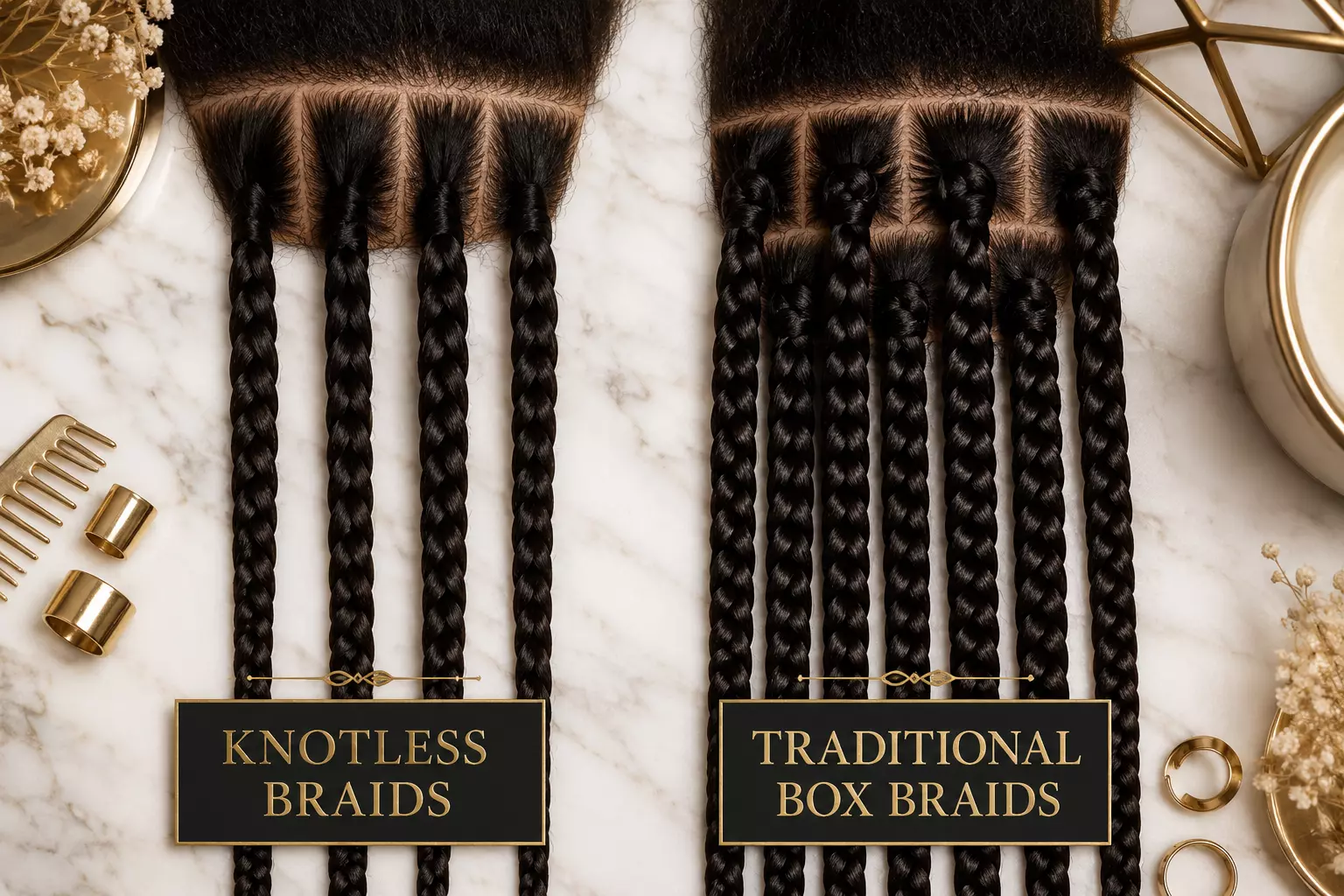
Traditional box braids have been a staple protective style for decades. The technique involves sectioning the hair into neat square or rectangular “boxes,” then anchoring synthetic or human hair extensions at the root using a folded knot. That knot is the signature — it creates an immediate, secure hold right at the scalp.
Here’s what the process looks like:
- 🔲 Hair is sectioned into uniform boxes
- ✂️ Extension hair is folded in half and looped around the natural hair
- 🪢 A knot is tied at the base to lock the extension in place
- 💇🏾 The braid continues downward from the knotted base
The result is a full, uniform braid that starts thick right from the scalp. This style has been worn by icons from Janet Jackson to Brandy, and it remains one of the most recognized protective styles in the world.
Knotless Braids: The Modern Evolution
Knotless braids use a feed-in technique — meaning the braider starts with only your natural hair and gradually adds small pieces of extension hair as the braid progresses downward. There is no knot at the root. The transition from natural hair to extension is seamless and gradual.
The process looks like this:
- 🔲 Hair is sectioned into similar boxes
- 🌿 The braid begins with natural hair only
- ➕ Small pieces of extension hair are fed in as the braid moves down
- 💆🏾 The result is a flat, smooth root with no tension point
“Knotless braids changed the way I think about protective styling. For the first time, I didn’t wake up with a headache after getting braids.” — A sentiment shared by countless clients and stylists in the natural hair community.
Scalp Health and Tension: The Most Important Difference
This is where the conversation gets real. When we talk about Knotless Braids vs. Traditional Box Braids: Which Is Better for Your Hair?, scalp health is arguably the most critical factor.
The Problem with Knots at the Root
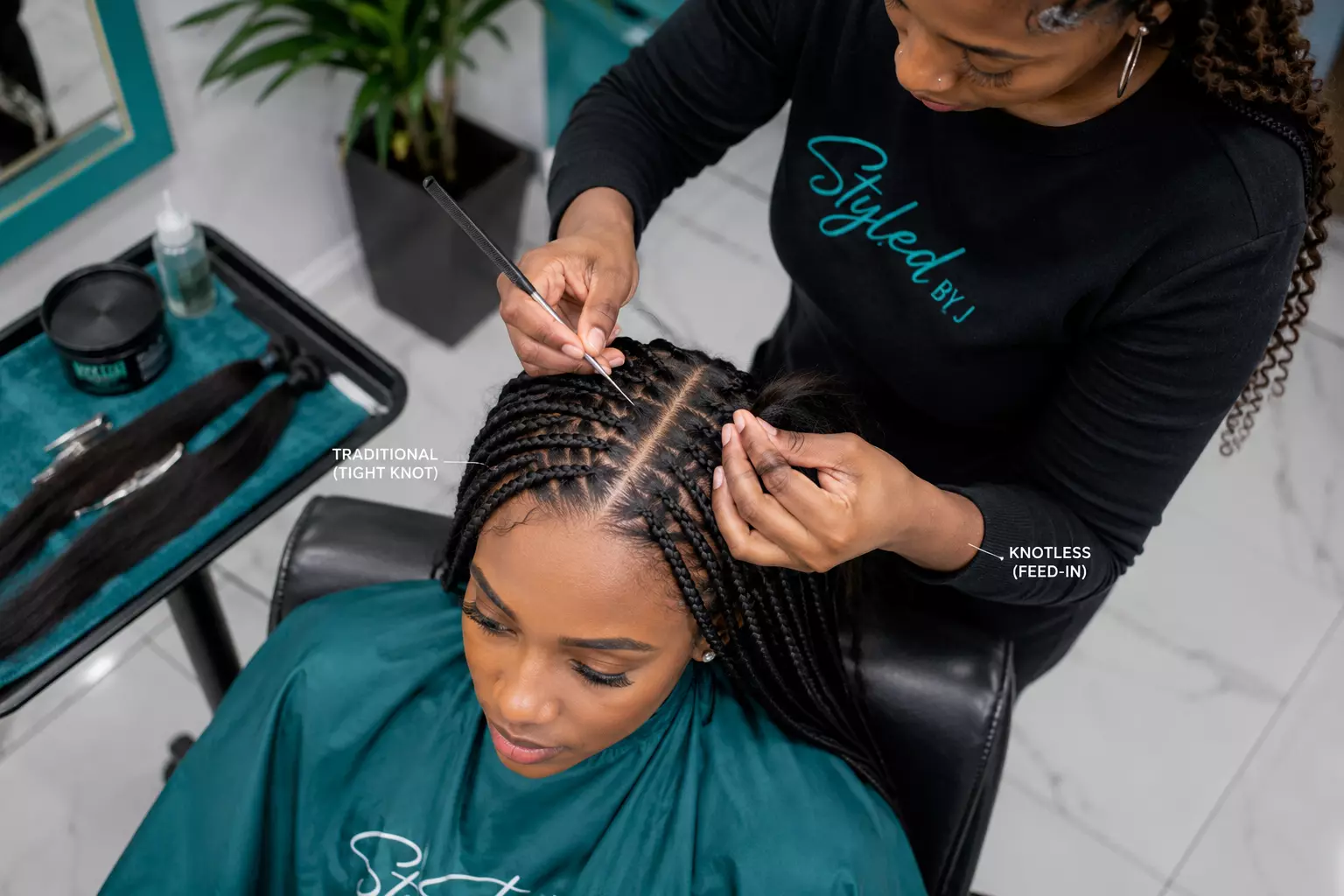
Traditional box braids place immediate, concentrated tension at the scalp the moment the knot is tied. This tension:
- Pulls on hair follicles from the very start
- Can cause traction alopecia over time, especially along the hairline
- Often leads to headaches in the first 24–48 hours after installation
- Can cause folliculitis (infected hair follicles) if the scalp is not properly cared for
People with fine, fragile, or already-thinning edges are particularly vulnerable. If you’ve ever noticed small bumps along your hairline after getting box braids, that’s your scalp telling you the tension was too high.
Why Knotless Braids Are Gentler
Because knotless braids begin with your natural hair and gradually introduce weight, the tension is distributed more evenly along the length of the braid rather than concentrated at the root. This means:
✅ Less immediate pulling on hair follicles
✅ Reduced risk of traction alopecia
✅ Fewer post-installation headaches
✅ Better suited for sensitive scalps and fine hair textures
However, it’s important to note that knotless braids are NOT tension-free. A braider who works too tightly can still cause damage with knotless braids. Technique and braider skill matter enormously.
Who Should Prioritize Scalp Health?
| Hair Type | Recommended Style |
|---|---|
| Fine or fragile hair | Knotless braids |
| Thinning edges or alopecia history | Knotless braids |
| Thick, dense natural hair | Either style works |
| Active scalp conditions (psoriasis, etc.) | Consult a trichologist first |
| Healthy, resilient hair | Either style works |
Installation Time, Cost, and Longevity: The Practical Breakdown
Let’s talk about the real-world factors that influence which style you choose — because scalp health isn’t the only consideration when comparing Knotless Braids vs. Traditional Box Braids: Which Is Better for Your Hair?
Installation Time
This is one of the most significant practical differences between the two styles.
Traditional box braids:
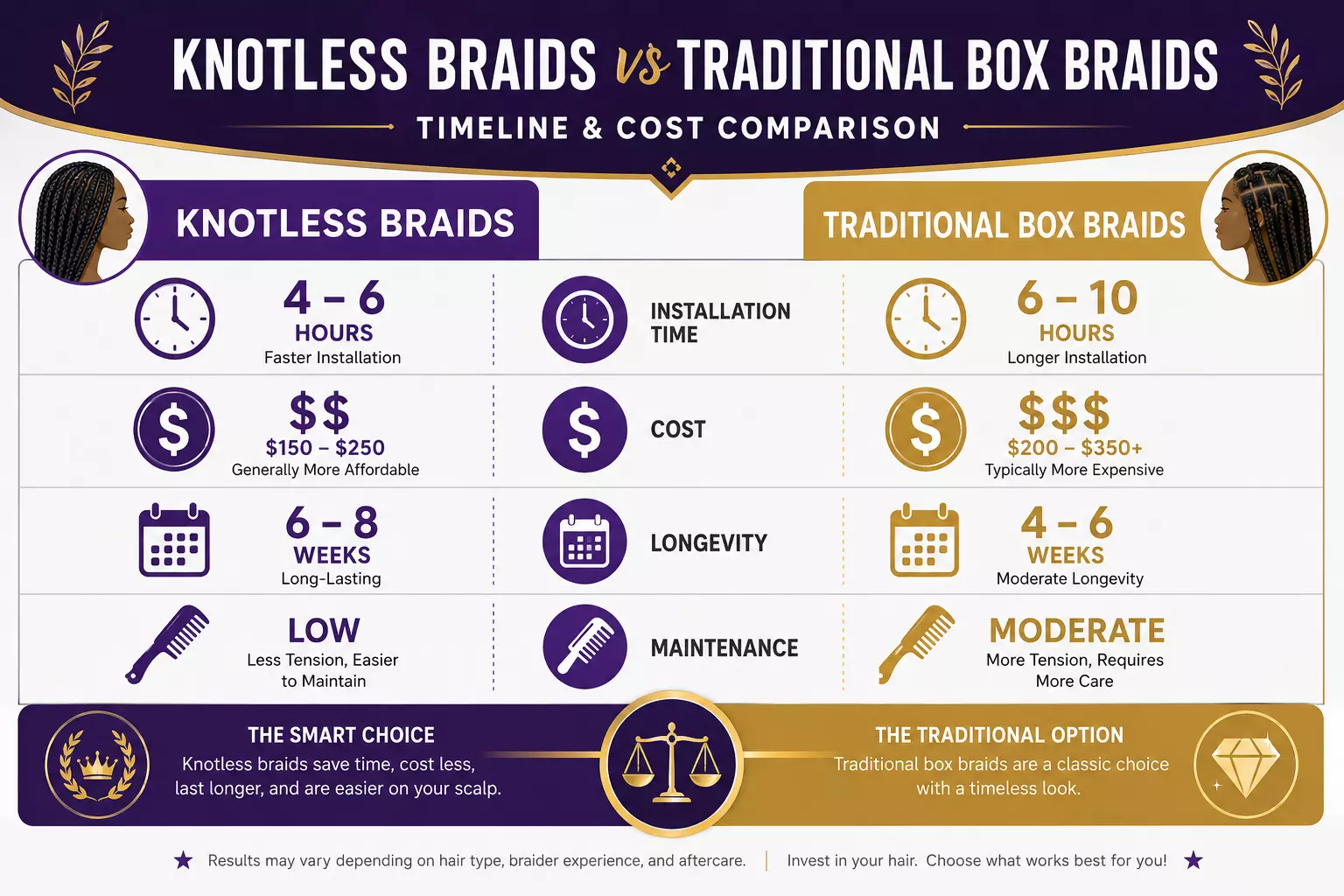
- Average installation time: 4–6 hours
- The knot technique is faster because it secures extensions immediately
- Large box braids can be done in as little as 3 hours
Knotless braids:
- Average installation time: 6–9 hours (sometimes longer for small braids)
- The feed-in technique requires more precision and time per braid
- Small knotless braids can take 10–12 hours or more
⏰ Bottom line: If you’re short on time, traditional box braids are the more efficient choice.
Cost Comparison
The additional time and skill required for knotless braids directly impacts the price.
| Style | Average Cost (2026) | Time in Chair |
|---|---|---|
| Traditional Box Braids (medium) | $150–$250 | 4–6 hours |
| Traditional Box Braids (small) | $200–$300 | 5–7 hours |
| Knotless Braids (medium) | $200–$350 | 6–9 hours |
| Knotless Braids (small) | $300–$500+ | 8–12 hours |
Prices vary significantly by location, braider experience, and hair length.
Longevity and Wear Time
Here’s where traditional box braids have a genuine advantage:
- Traditional box braids can last 6–8 weeks with proper maintenance
- Knotless braids typically last 4–6 weeks before the roots begin to look noticeably grown out
The knot in traditional braids creates a more secure anchor, which means the style holds its shape longer. Knotless braids, because they start with natural hair, can show new growth more quickly, which some people find less aesthetically appealing over time.
Maintenance tips for both styles:
- 🧴 Moisturize your scalp with a lightweight oil every 3–5 days
- 🛌 Sleep with a satin bonnet or on a satin pillowcase
- 💧 Diluted shampoo wash every 2–3 weeks
- 🚿 Avoid over-wetting braids, which can cause mildew and frizz
Aesthetics, Versatility, and Styling Options
Beyond health and practicality, style matters. A lot. Let’s look at how these two techniques compare visually and in terms of versatility.
The Visual Difference
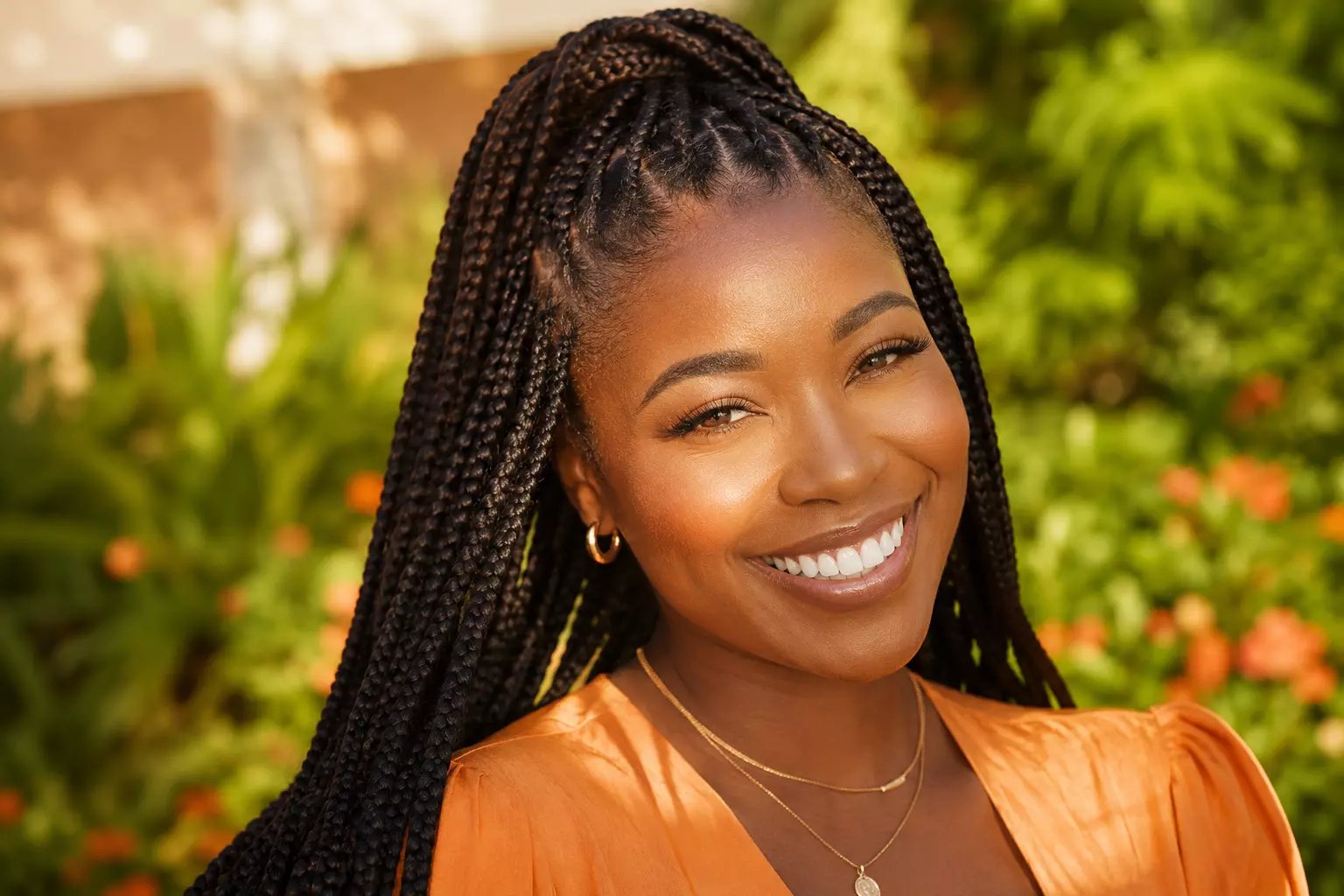
One of the most immediately noticeable differences is how each style looks at the root.
- Traditional box braids have a slightly raised, knotted root that creates a subtle bump where the extension begins. Some people love this look for its boldness and definition.
- Knotless braids lie flat against the scalp with a seamless, natural-looking root. Many people find this more polished and natural in appearance.
💬 “Knotless braids photograph beautifully because the roots look so clean and natural. For events and photoshoots, they’re my go-to.”
Styling Versatility
Both styles offer excellent versatility, but they differ slightly in what looks best:
Traditional box braids excel at:
- High buns and puffs (the knot gives structure)
- Bold, statement styles
- Styles that require the braids to hold their shape under tension
Knotless braids excel at:
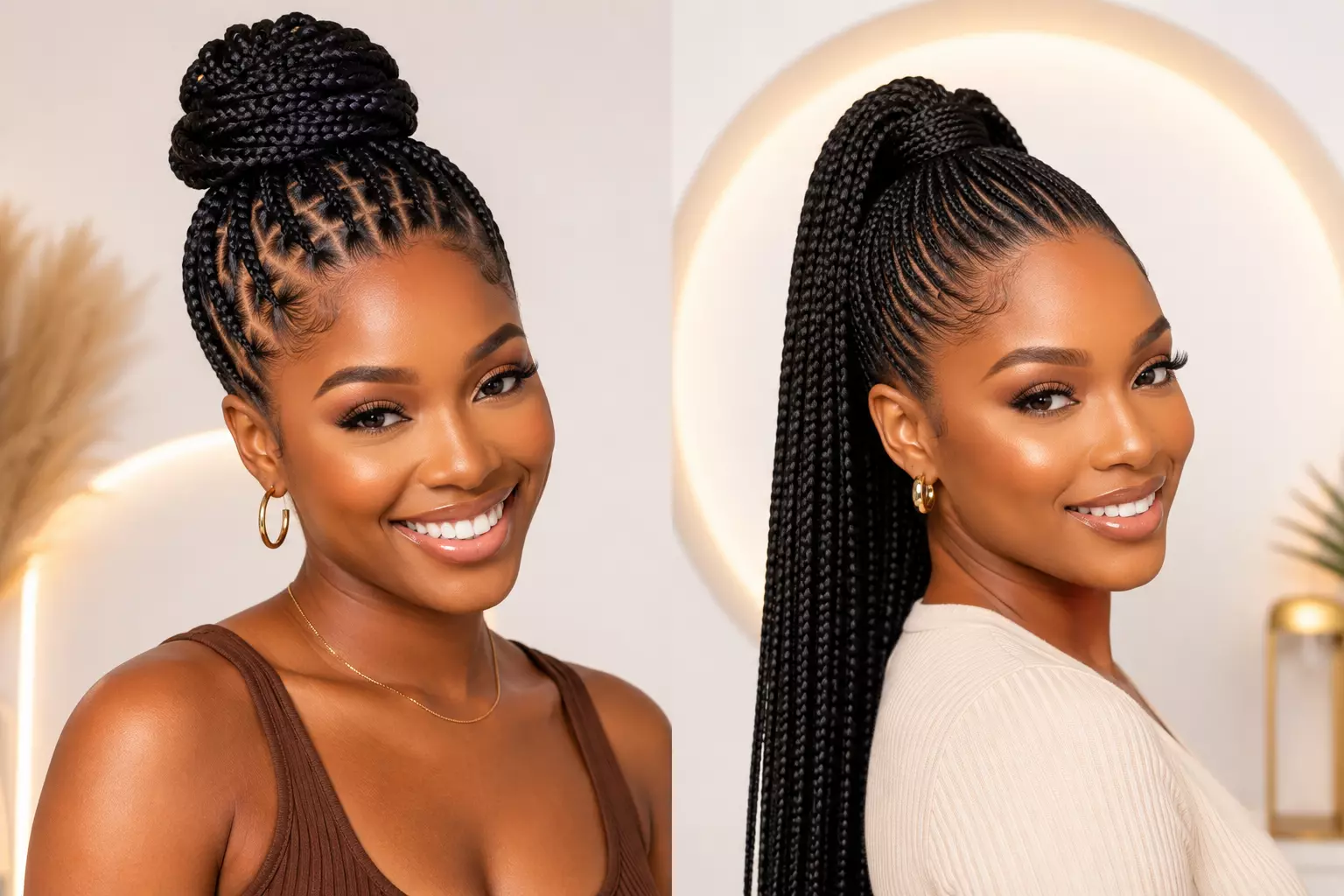
- Sleek ponytails and half-up styles (flat roots look seamless)
- Parted styles where the scalp is visible
- Natural, low-manipulation everyday looks
- Styles photographed up close
Size Options
Both styles come in a range of sizes:
| Size | Description | Best For |
|---|---|---|
| Jumbo | Very thick, chunky braids | Quick install, bold look |
| Large | Classic full braids | Balanced time and style |
| Medium | Most popular size | Versatile everyday wear |
| Small | Thin, delicate braids | Longevity, intricate styling |
| Micro | Extremely thin braids | Maximum longevity, high commitment |
Making the Right Choice: A Side-by-Side Decision Guide
Now that we’ve covered the key factors, let’s bring it all together. The question of Knotless Braids vs. Traditional Box Braids: Which Is Better for Your Hair? ultimately comes down to your individual needs.
Choose Knotless Braids If You:
✅ Have a sensitive scalp or history of traction alopecia
✅ Prioritize scalp health and hair growth retention
✅ Want a natural, seamless look at the roots
✅ Have fine or fragile hair
✅ Are willing to invest more time and money
✅ Plan to wear styles where the scalp is visible
Choose Traditional Box Braids If You:
✅ Are working with a tighter budget
✅ Need a quicker installation
✅ Want maximum longevity from your style
✅ Have thick, resilient hair with no scalp sensitivity
✅ Love bold, structured braid aesthetics
✅ Are an active person who needs a style that holds up longer
What About a Hybrid Approach?
Some experienced braiders offer a hybrid technique — using a modified knot that’s smaller and less tight than traditional methods, combined with a partial feed-in approach. This can offer a middle ground between the two styles. If you’re curious, ask your braider if they offer this option.
Questions to Ask Your Braider Before Sitting Down
Before your next appointment, consider asking:
- 🗣️ “How tight do you typically braid? Can you go lighter on my edges?”
- 🗣️ “How long will this style take?”
- 🗣️ “Do you offer knotless, traditional, or both techniques?”
- 🗣️ “What products do you recommend for maintenance?”
- 🗣️ “Have you worked with my hair texture before?”
A skilled, communicative braider is just as important as the style you choose.
Common Myths Debunked 🚫
There’s a lot of misinformation floating around about both styles. Let me clear up a few things:
Myth #1: “Knotless braids are always tension-free.”
❌ False. The technique reduces tension, but a heavy-handed braider can still braid too tightly. Always communicate during your appointment.
Myth #2: “Traditional box braids always cause hair loss.”
❌ False. Millions of people wear traditional box braids without any hair loss. The key is proper installation tension, not leaving braids in too long, and proper aftercare.
Myth #3: “Knotless braids don’t last as long because they’re weaker.”
❌ Partially false. They don’t last as long primarily because new growth shows faster, not because the braids fall apart more quickly.
Myth #4: “You can’t get knotless braids if your hair is short.”
❌ False. Skilled braiders can create knotless braids on shorter natural hair, though very short lengths may require more skill to execute well.
Myth #5: “The more expensive the style, the better it is for your hair.”
❌ Not necessarily. A gentle, skilled braider doing traditional box braids can be far better for your hair than a rough braider doing knotless braids at a premium price.
Conclusion: The Verdict on Knotless Braids vs. Traditional Box Braids
After breaking down every angle of the Knotless Braids vs. Traditional Box Braids: Which Is Better for Your Hair? debate, here’s the honest truth: neither style is universally better. The best choice is the one that aligns with your hair’s specific needs, your lifestyle, and your budget.
If scalp health and hair retention are your top priorities — especially if you’ve experienced traction alopecia or have fine, fragile edges — knotless braids are the smarter investment. The reduced tension and seamless root entry make a measurable difference in long-term hair health.
If you’re working with a budget, need a style that lasts longer, or simply love the bold, structured look of traditional box braids — and your hair and scalp can handle the tension — traditional box braids remain a completely valid and beautiful choice.
Your Actionable Next Steps 🎯
- Assess your scalp health — If you’ve had tension headaches, bumps, or thinning edges after braids, switch to knotless.
- Research braiders in your area — Look for stylists who specialize in the technique you want and check their portfolio.
- Set a realistic budget — Factor in both the installation cost and the maintenance products you’ll need.
- Communicate clearly — Tell your braider your tension preferences before and during installation.
- Give your hair a break — Regardless of which style you choose, take at least 2–4 weeks between installs to let your scalp recover.
Your hair is worth the research. Whether you go knotless or traditional, the best braid is one that leaves your scalp healthy, your edges intact, and your confidence soaring. 💫